Showing posts with label book review. Show all posts

Friday, January 24, 2020

Fiction Friday: STONY MAN DOCTRINE

My first cover-to-cover read of 2020 was this classic. I first read STONY MAN DOCTRINE back in either junior high or high school - I can't recall which - as my schools had a lot of donated fiction and someone must have had a collection of Gold Eagle titles. I remember back then thinking how amazingly badass the GE books were, with tons of technical detail and blistering action scenes.
For those of you totally in the dark here, SMD is the first book in Gold Eagle Books' Three-Series "Stony Man" world (I guess Sons of Barabas is also in this world but I don't really count it here) which encompasses the Mack Bolan Executioner series, the Able Team series, and the Phoenix Force series. Essentially the three men of Able Team and five men of Phoenix Force work for Bolan, and in this book they're all brought together for the first time to take on a multi-national terrorist organization called Hydra (no, not THAT Hydra), which is planning to carry out a series of WMD-style chemical weapon attacks against major US population centers unless the US government withdraws all military forces from foreign countries. The President decides that he cannot abandon America's allies, so he calls in Bolan and Co. to hunt down the terrorists and wipe them out.

Reading this again thirty years later, it is still entertaining action fare. The usual Gold Eagle titles are far slimmer than this book, but the author is able to stitch together what're basically two and a half novels' worth of action in order to deliver the first "Super-Bolan" book. Instead of action-interlude-travel-action-interlude-travel as you have in, say, an Able Team novel, this book can just go from team to team to team and keep the action coming.
One thing I did forget about this book was how early on in the lives of the Able Team and Phoenix Force series this took place. I believe it's right around the same time as Able Team #6, and Phoenix Force #5. It was definitely a cool idea someone had to bring all three series together for a big operation, but it is also evident of why it wouldn't work as a formula for every book - the end battle alone, where all nine combatants are fighting, just doesn't give enough "screen time" to each of the characters, and winds up jumping around a lot in order to show us what everyone's doing.
Overall, pretty darn entertaining, and I'm glad to have been able to re-read it after such a long period of time and not be crushed that it wasn't as awesome as I'd remembered.

Friday, September 20, 2019

Fiction Friday: The Stonehaven League LitRPG Series

The "LitRPG" genre of fiction is...a weird one. It's not actually that new, however. The premise is that these stories revolve around characters who exist within a "game world", i.e., a world that is artificial and created as part of a game. The degree of artificiality in LitRPG stories can be very obvious, or the world can feel completely real, but still exist only as a result of some kind of game.

The first novel that I know of which seems to fall into this kind of genre, although it wasn't called LitRPG at the time, was Andre Norton's 1978 novel Quag Keep, a story about a bunch of adventurers in a medieval-type world who are actually people from Earth who were playing a role-playing game. Given that Dungeons and Dragons was roughly four years old at the time Quag Keep was published, Norton got on the bandwagon fairly early. Many others have followed over the years, one of the most notable being Joel Rosenberg's Guardians of the Flame series, which started in 1983 with The Sleeping Dragon. Beyond the written word, one would consider the '80s Dungeons and Dragons cartoon series to be a form of this kind of genre, as would, I feel, the movie TRON.

But the modern form of the LitRPG novel is more commonly based around computer games, and more specifically, not people transported to worlds, but rather, immersed in them through play. As virtual reality is more common these days in gaming (and is growing bigger every day), the idea of putting on VR gear and submerging yourself as your character in a game world is very real. In fact, Ready Player One  is a perfect example of this.

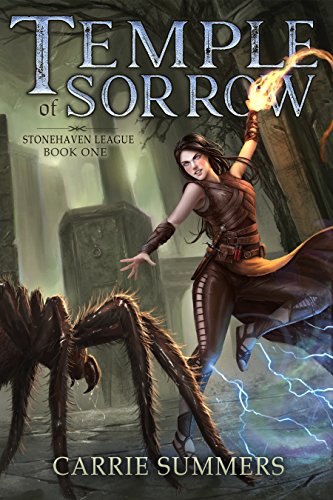
Enough background, though. Author and former (?) game developer Carrie Summers has written an engaging series of LitRPG / GameLit novels, which in the "real world" are set a few decades in the future, where virtual reality gaming has extended all the way to cybernetic implants that dump the virtual reality of the game right into our brain's perception of reality. In her first book, Temple of Sorrows, a young woman named Devon leaves her crappy job to work as a kind of "super-tester" for a gaming company, Relic Online, in order to push the game and it's artificial intelligence to the limits of what a capable, creative player can do.

Devon logs into the game, stunned at how the direct neural connection to the game world seems so incredibly real - she can feel the wind and the sun, the grass under her feet and the cloth of her clothing. Yet, the world still acts as a Computer Role-Playing Game. She has skills and abilities and she gains experience and levels up. When she kills a monster, the touch of a blade turns the monster's body into "loot" that can be used for other things. Anyone who has played a computer RPG in the last...twenty years or so will be familiar with the tropes of the world and its setting.

I don't want to give the plot away, but suffice to say, there is plenty going on in both the real world and the in-game world. This leads to dangers on both sides for Devon, something that I found interesting as it kept the story from being completely about her adventures in-game, and raised the stakes a little. And while this book is probably perfectly fine for a YA audience, there is a good deal of violence going on, so those who want action will get that, while those who like the puzzle-solving and "game-ness" of a game world will also have something to look forward to.

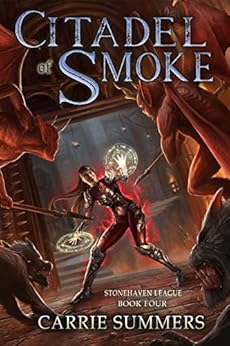
Overall, this is an enjoyable series. If I remember right, I've read the first three books, and I am just starting the fourth. with six books currently in the series. These books are all available in Kindle (for purchase or Kindle Unlimited) and paperback, and the first four are currently available as audiobooks. If this seems in any way interesting to you, I definitely recommend checking them out.

Friday, September 13, 2019

Fiction Friday: THE LAST WISH: Introducing the Witcher

If you follow video gaming at all, you've likely heard of The Witcher series of open-world RPG video games. They feature the monster-hunting Witcher, Geralt of Rivia, wandering the world and killing that which goes bump in the night. The world of the Witcher is based around Slavic folklore, a flavor of Western monster mythology that is a little removed from what most of us are used to unless you are really into the subject of bestiary folklore.

But fewer people realize that the Witcher and his world started out as a series of short stories and novels by Polish author Andrzej Sapkowski. Most of the stories were written in the 1990s, but it wasn't until the mid-oughts and later that they were given English translations. Coming at the end of this year, Netflix is releasing a television series based around the stories, and of course both fans of the books and the video games are howling over how the details shown in the trailer don't do the series justice.

Curious about both such a popular video game character and what might drive Netflix to pick up the IP, I grabbed the first (chronologically) anthology of short stories, THE LAST WISH. I was immediately hooked. For a book translated from a different language, the prose is evocative and pulls you right into the world, a very dark, late medieval-era feeling fantasy realm, very similar to the Ravenloft setting of Dungeons & Dragons. If you aren't familiar with Slavic folklore, some of the creatures might seem unusual to you, but that slightly alien nature just adds to the creepiness of the setting - this isn't some adventurer going after your usual orcs and goblins, this is a true monster hunter, for whom a blend of swords, sorcery, and dark knowledge is needed to take on the evils lurking in the deep forests and crumbling towers.

So if you like dark fairy-tale fantasy with an Eastern European bent to it, do yourself a favor and check out Sapkowski's fiction. I'll definitely find time this fall to work my way through more of Geralt's adventures.

Monday, September 9, 2019

Media Monday: The Kindle eBook Reader

I'm not sure when I bought my first eBook. It was probably around 2010, and I think I would have bought it using the Kindle app on a work-provided iPad. Not much later, or perhaps around the same time, I had the app on an iPod Touch (I didn't have a smartphone). This was around the time that I was starting to connect with other authors, and I was beginning work on my first novel, as well as tinkering with short story concepts. Many of the older authors I was talking to were reclaiming rights to their backlists, while newer authors were experimenting with self-publishing, so I bought a few eBooks and began to read.

Reading on an iPod Touch was OK, especially since the device was small and easy to carry around. Reading on a 1st Generation iPad was more cumbersome, since the tablet is large and comparatively heavy. It is also quite bright if the screen is turned up, but when the brightness is lowered, it is much harder to use. The irritation of having a bright screen shining in my face at close range made reading for extended periods of time rather uncomfortable. Still, I liked the various features the Kindle app provided - the ability to "whispersync" your place in an eBook across multiple devices, and of course, the ability to instantly buy and download a new book. It did not take long for me to see the many benefits in eBook technology.

My 2011 Kindle (left) and 2013 Kindle Paperwhite (right)

Shortly after publishing my first pieces of short fiction in 2011, I decided it was time to get a Kindle. I bought it in December of 2011, and was immediately impressed. While the keyboard might make it a little intimidating or "retro" at first, and the e-ink contrast isn't as sharp as later models, I immediately found the e-ink technology extremely comfortable to read. There was no light shining directly into my face, the side buttons turning the page allowed one to keep reading with a brief twitch of my thumb, and the ability to adjust font size, line spacing, and character density made reading very easy on my eyes, which is especially important for me, as my eyesight isn't great, and paperback fonts tend to be small and cramped.

A little more than a year later, I did buy a 7" Samsung tablet, and while it was so much better to read on than my tiny smartphone or the large, cumbersome iPad, it still shined a bright light in my face, and once I purchased a larger LG smartphone, I found the tablet redundant. A few months later, addressing the one major flaw in my Kindle (the lack of a reading light), I bought a Kindle Paperwhite in 2013. While I missed the buttons - and it was harder to take notes with the touch keyboard vs the actual physical button keyboard - the Paperwhite was smaller, lighter, and the adjustable light, which shown across the page, rather than out from behind it, made reading in low light extremely easy.

Way to be an elitist shitbag!
There are a lot of people out there who speak derisively of eBooks and Kindles. Some complain that Amazon doesn't use the EPUB file format, which means Amazon eBooks don't work on other e-readers. They complain that eBooks purchased on other platforms don't work on the Kindle. Neither of these arguments really bother me, since the only two e-ink competitors are the Nook and the Kobo, and frankly, if you tied your line to either of those brands, I'm sorry to say, you've got problems. Beyond that, apps from other booksellers can install on most phones and mobile devices, regardless of file type. Other people complain about DRM (Digital Rights Management - aka, anti-piracy technology), but frankly, that's put in place at the request of the publisher, not the distributor, so if you have a problem with an Amazon eBook having DRM, write the publisher, not Mr. Bezos.

And of course, there's the "I just love books" argument. People love the feel of a book, the smell of paper, the act of turning pages, blah blah blah. Look, no one is forcing a Kindle into your hands and dragging your books out of your house to throw into the back of a dump truck. Contrary to popular opinion, Marie Kondo isn't telling you to ONLY keep 30 books in your house (I have her book - in paper no less - and she says no such thing). For some reason, people seem to think that proponents of eBooks live some weird minimalist, digital-only lifestyle. I own two e-readers, and I've got sixteen bookcases filled to the damn brim with books. There's books everywhere you turn in my home, and you know what - that's one of the reasons I like the Kindle. I don't have to go digging through piles and bookcases looking for a book, it's right there in the Kindle inventory. I don't need to worry about packing "backup" books when I go on a trip, because I've already got several hundred right there with me.

Mmmm, smells like mold, cigarette smoke, and cat piss.
Does it need to be recharged? Sure, maybe every couple of weeks it needs to be plugged in for a couple of hours. My phone needs to be recharged every day, sometimes twice a day depending on how much I use it. A laptop might need to be recharged every few hours. Compared to most of the electronic devices you use every day, the Kindle, comparatively, lasts an order of magnitude longer. Both of mine are 6+ years old, and I can still read 2-3 novels on them before the battery runs out. It takes the barest minimum of device power management to make this a non-issue. And, other than that, I don't see many drawbacks to these devices. The Paperwhite weights about the same as a paperback novel, and the newer versions of the Kindle line are even lighter.

In conclusion, eBooks and the e-reader have completely changed the way I buy and read books, making it a much more immediate experience. I still buy used, vintage paperbacks for my collections, and I still buy paper books for research because it is easier to find a specific page or diagram in a paper book, but for casual, leisure reading, it's almost exclusively done via eBooks.

Friday, September 6, 2019

Fiction Friday: The Original Dragonlance Chronicles Trilogy

Just a quick post today as I wrap up a busy work week. I cribbed this off of my Facebook feed in response to a Tor Books post about the original "Chronicles" Dragonlance tie-in novels, and how formative those novels were to a generation of role-playing gamers and fantasy enthusiasts. For many folks (myself included) we read these books before Conan or Lord of the Rings.

You can read the Tor.com article here.

No joke, I think the author stole the memories of my early teenage years and used them to write this piece. Until maybe my sophomore year of high school, I'd always eschewed fantasy and science fiction in favor of shoot 'em up men's adventure and espionage thrillers, until one day a classmate of mine loaned me these three books. This was at least a year before I first played Dungeons & Dragons, and long before I tried reading The Hobbit or Lord of the Rings. I still have my original three paperbacks, bought after reading this for the first time almost 30 years ago.

After getting into D&D, I did buy the second edition "Tales of the Lance" boxed set, although I never did play it. Frankly, I feel like it isn't really superior to the Dragonlance Adventures hardcover for 1E that came out in the '80s. I remember seeing this advertised in the back of comic books, before I got into D&D or really understood what it was or how it played. I remember staring at this all the time, thinking it seemed like the most badass thing I could imagine. When I got into D&D later on, I did buy the 2nd edition Tales of the Lance boxed set, but just didn't appreciate it as much as the 1E Dragonlance Adventures hardcover, which I acquired in a used book store my freshman year of college.

It has been years since I re-read the original trilogy. I started re-reading Kindle editions, and while it didn't disappoint, I had read them so many times, knowing what was about to happen meant I eventually started reading something else and didn't get back to it, but yeah, I do want to give 'em another go, although I am a little nervous as to whether they'll hold up or not. It is simply a matter of remembering that they represent fantasy and RPGs at a certain particular point in time, and appreciate them for what they are, instead of criticizing them for what they are not.
 

Friday, August 30, 2019

Fiction Friday: Matthew Phillion's THE INDESTRUCTIBLES Series

Although I have, over the years, dabbled in reading comics and following along with various comic book characters, I was never really particularly drawn to the super-hero genre specifically. I preferred characters like The Punisher or Conan the Barbarian, or comic book stories that weren't really super-hero focused, at least in the traditional sense, like the PREACHER series, or WATCHMEN (which has super-heroes, but wow, not so super or so heroic).

All that having been said, with the meteoric rise in Young Adult fiction over the last twenty years, especially as it touches on sub-genres like Urban Fantasy, I've seen several authors out there who tie in YA fiction with more traditional super-hero tropes (Percy Jackson kinda feels like this, although the characters are technically Greek demi-gods, but whatever). Again, this really isn't my cup of tea, so for the most part, I've ignored this genre, feeling it's not really something I find interesting.

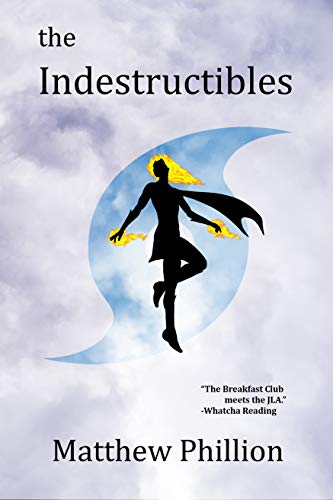
A couple of weeks ago, I decided to give Matthew Phillion's THE INDESTRUCTIBLES a shot. I've been social media pen pals with Matt for a few years, and I've read his DUNGEON CRAWLERS novellas (also highly recommended). I knew he was a skilled storyteller, so I took the plunge, and I read Book 1 of his YA supers series.

To say that I was pleasantly surprised at how good it was is a bit of a slight to Matt, so I will say instead that I was surprised how easy it was for me to slide into the YA superhero genre with this first book. The characters were fun and engaging, and his writing style is clean and evocative, without feeling simplistic or dumbed-down for a younger audience. I have since read books 2 and 3, and I am currently well into book 4. The series currently extends to a fifth book, as well as several associated short stories, and there is a separate two-volume book series that exists in the same world and timeline as the Indestructibles characters.

If you enjoy super-hero fiction, or if you have or know a young adult reader who enjoys this kind of fiction, please go check out Matt's work on Amazon. His books are available in Kindle and paperback formats, and he's also made them available via Kindle Unlimited.

Monday, August 26, 2019

Media Monday: Death Kiss

A bit of a brief post today, as I'm in what's typically the busiest week of the year at work. If you've been around this blog for any amount of time, you know my fascination with the DEATH WISH series, both the two books written by Brian Garfield, as well as the *five* movies made starring Charles Bronson. And of course, it's no secret that much of my fiction writing is inspired by the notion of the urban vigilante.

So I was definitely curious when the micro-budget crime movie DEATH KISS came onto the scene. Basically, you can treat it as an unauthorized, unofficial follow-up to the Death Wish film franchise, although that is never truly acknowledged. Death Kiss is available on Amazon Prime Video, and you can check out the trailer here:


Just as interesting as the movie (and perhaps for some people, even more so), pulp aficionado Bill Cunningham of Pulp 2.0 Press has written a book that does a great job of breaking down the production and marketing of Death Kiss from a business perspective.  Allow me to quote my review of his book Death Kiss - the Book of the Movie, here:

To preface, I have seen DEATH KISS and read through Cunningham's dissection of the film, and I write this review from the point of view of a novelist and storyteller, as well as someone who went through film school in the late 1990s, when low-budget independent film-making was on the mind of many of my fellow classmates. I am also a huge fan of Brian Garfield's original DEATH WISH novel, as well as the 1974 adaptation by Michael Winner. I've put out articles about vigilante storytelling, and have written a bit of it myself.

I say all this because the idea of an indie project designed specifically to tap into that Garfield/Bronson/Winner-inspired vigilante crime story market was immediately appealing to me. I watched the film DEATH KISS before reading the "Cinexploits!" case study, and while there were portions of the film that I might have criticisms about, I think overall, with the resources available to the director, the overall final product was entertaining - I honestly enjoyed it more than the 2018 remake with Bruce Willis!

And so, having seen the film, I decided to read the DEATH KISS case study. It is an excellent breakdown of the idea behind the film, and how so often in the entertainment industry, the people you know and the connections you make - both "above the line" and below - can make or break the project before it even goes into production. The relationship between Rene Perez and Robert Kovacs - a man with, shall we say, a particular set of skills - allowed the idea of a DEATH WISH-styled independent film to grow from the seed of an idea into a full-bloomed production.

Further, and this is something I especially take to heart as a novelist, Cunningham takes a lot of time to discuss the pragmatic, commercial, *business* of film-making - about making sure that your idea isn't just a good story, but that it is a story you can *sell*, and knowing what markets would be best for your idea, and making sure that you are delivering a product that fits with those markets. Artistic storytelling for the sake of storytelling is a noble concept, but it doesn't pay the rent or the talent. If you are in the *business* of film-making, you must understand first and foremost that your business is commercial in nature, and that you must, above all else, make money from the sale of your product. Period.

Of special note is the breakdown of the ARKOFF Formula. I won't go into the details here, but it is a point-by-point process epitomized by the methodology of Samuel Z. Arkoff, who did great business during the second half of the 20th century producing and distributing commercial theatrical films. I find the ARKOFF Formula worth studying by anyone who has an interest in storytelling designed to - first and foremost - get people to part with their money.

As this review is already fairly lengthy, I will end it by pointing out that the book also includes the DEATH KISS script, as well as a lot of great details about low-budget film production. As part of my day job I regularly interact with faculty and staff that support student film-making, and I have been in many a meeting where people argue for the best film cameras and the best lenses and the most expensive NLE hardware builds and finishing spaces. While more money and resources usually doesn't *hurt*, it often puts people in the mindset that more money is the answer to the practical problems they face during production. However, you don't tell a better story because you don't have the most expensive lens, or because you're only shooting in 1080 vs. 4K. Good stories are still good stories, even if they are produced on non-Hollywood grade production equipment. It is skill, talent, and ingenuity that tells great stories, not the most expensive ARRI rig you can get from a rental house.

If you have an interest in independent film-making, commercial storytelling, or even just the idea of taking a 1970s cult hit and using its gravity to slingshot an idea forty years later, I highly recommend you get your hands on DEATH KISS: The Book of the Movie.
So if you are a fan of low-budget film-making, a fan of vigilante action, or a blend of both, check out both the movie and the book.

Friday, August 23, 2019

Fiction Friday: Paul Bishop Presents Anthologies

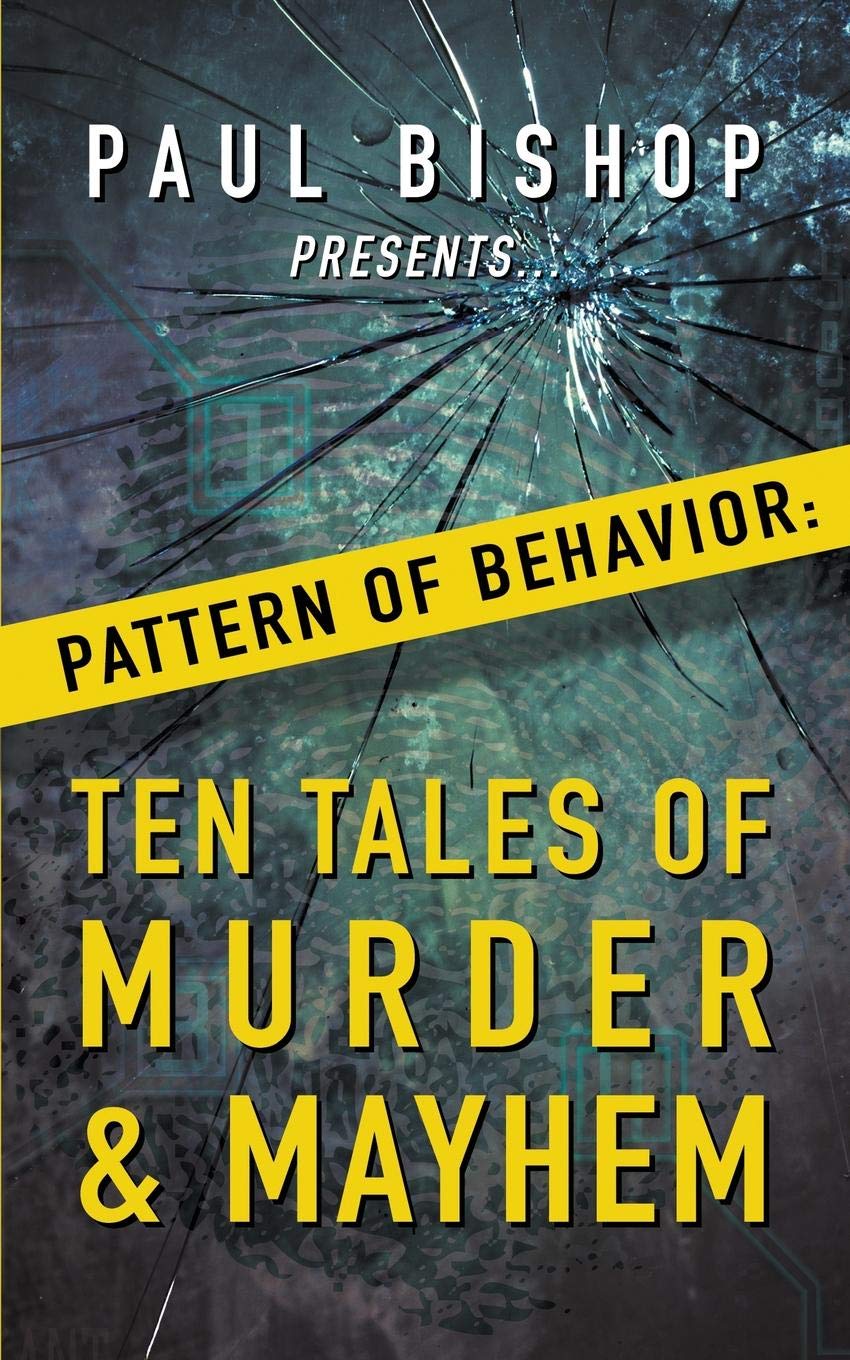
Astonishingly, the third post of the week! I'm reserving Fridays for fiction posts, and today's post will be a little shorter than the posts on Monday and Wednesday. I wanted to highlight a series of fiction anthologies being put out by Wolfpack Publishing, and curated/edited by Paul Bishop, a retired LAPD detective and venerable novelist. The first anthology, Pattern of Behavior I read as soon as it was released, and while not every one of the stories was entirely my bag, so to speak, all of them were well-crafted tales from highly-talented authors.

There is a second book in the series out now, Criminal Tendencies, and although I have yet to start reading it, I must humbly mention that I have a story in that volume, one featuring my character Jamie "Hangman" Lynch, the protagonist from my novel SAN FRANCISCO SLAUGHTER. If you liked that novel and want to read some more of the Hangman dealing out some bloody vigilante vengeance, look no further (for now) than Criminal Tendencies.

I do believe there is one more entry forthcoming in Paul's series of crime anthologies, and after that, there is at least one Western anthology on the horizon. All of these are (or will be) available in eBook and trade paperback form, and not only are they priced to move at $0.99 apiece, they are available through Kindle Unlimited as well.

Lastly, I highly encourage anyone interested in crime and mystery fiction to go to Paul's Amazon page and check out the full range of his published works. Paul was one of the authors I connected with early on in my blogging and writing journey, and I am more than happy to promote his publishing ventures whenever and wherever I can.

Wednesday, February 28, 2018

Revisiting Brian Garfield's DEATH WISH

More than seven years ago, while I was writing KILLER INSTINCTS, I read Brian Garfield's 1972 crime novel DEATH WISH for the first time. I'd seen the Charles Bronson film a couple of times before, but I wanted to read the novel because I'd been told it was significantly different from the film adaptation, and indeed, that is the case. Now, with a remake coming out this weekend starring Bruce Willis (no comment...), I've gone back and read the original novel again.

So I don't repeat myself, you can go here and read my original review of the novel.

Reading the novel now, I am struck by how, forty-six years after it was first released, the conversations that take place about crime and punishment, liberal and conservative politics, the role of the judicial system in criminal reform, the right of the individual to defend themselves versus the role of law enforcement to protect the public - basically every conversation we're having now, in 2018, they were having in 1972.

In fact, although it is closing in on being a half-century old, the novel is an incredible fictional exploration of walking through the transformation of a pacifistic, liberal, "bleeding heart", into a bloody-minded vigilante with a compulsion to stalk the streets, looking for just about any excuse to kill. Paul Benjamin is certainly the sort of guy who, if he was living in 2018, would be donating to GoFundMe campaigns for spree shooting victims, and changing his Facebook profile photo to "stand with" victims of the latest public tragedy. He would certainly vote for gun control, and insist that it is the role of law enforcement to deal with crime, not the private citizen, and he believes, to a degree, that a lot of violent crime in NYC is hyped up, that it is exaggerated by the media and by the conservatives demanding tougher laws - that it is, essentially, "fake news".

But of course, when the violence happens to him, Paul discovers that the system fails him at almost every turn. The police can't find the attackers, have essentially no leads at all, and it is immediately clear that Paul's personal nightmare is just one more file folder in a large stack sitting on the desk of a tired and over-worked police detective. Paul is overcome with helplessness and rage, incredulous at the notion that he's now just another statistic, that his friends and co-workers express just enough shock and sadness to fulfill their social obligation to him, but no more, because his tragedy makes them just too uncomfortable. Those scenes are almost textbook examples of "compassion fatigue", and when viewed from Paul's perspective, you can see how it just makes him even more angry at the situation he's in, and society's inability to, quite simply, do something about crime.

Of course, even more important in his transformation into a vigilante is Paul's all-consuming fear. He is nearly paralyzed by fear every time he leaves his apartment. A perfectly normal stroll down the street to get a newspaper turns into a terrifying experience - every rowdy youth or minority Paul passes by is a potential assailant, ready to turn and attack him at a moment's notice. At one point, Paul crosses the street and discovers himself a few steps from a black man just casually leaning against the side of a building, just chilling out, and Paul becomes a sweating, petrified mess expecting an attack. Only after running in fear from the man, who he later realizes was probably just minding his own business and laughing at the scared white guy, does Paul realize how deep the terror has taken hold of him.

Paul eventually arms himself with a roll of quarters in a sock for self-defense, and when he scares off a youth making a half-assed attempt at robbing him, the sense of power at being able to defend himself is almost a narcotic. Paul winds up buying a gun while on a business trip to Arizona (where all the locals tell him they can roam the streets safely at night because everyone has a gun), and he starts carrying it once back in NYC. Of course, with the gun in his pocket, Paul isn't unafraid - far from it. He is terrified of someone bumping against him and finding the gun. He's terrified of dropping the gun, or being stopped by a cop and having the gun discovered. He carries a wad of cash with the gun that he hops he can bribe the cop with if the gun is ever found, since he doesn't have a permit for it.

In fact, Paul only leaves his fear behind once he starts killing. The first murder is, ostensibly, self-defense, although he does begin wandering the streets and going into areas where he knows there is a high chance he might get mugged. His intentions the first time around aren't necessarily to kill a mugger, but a combination of determination to not let the criminals dictate where he can and cannot go, and a sort of symbolic "whistling past the graveyard". But, after the first shooting, and after he recovers from the initial emotional and psychological shock of shooting and killing another person, he loses his fear, and begins to actively "stalk" and go after criminals.

All in all, Paul kills eight people over the course of the book, and really, the action doesn't even take up eight pages. One of the victims is killed in only a couple of short sentences. All of the violence takes place in the second half of the book, most of it in the last third, really. And, once you reach the end of the novel, it is clear that the book is in no way about the shootings, but rather, Paul's vigilantism is used as the lens through which the author is addressing crime in the modern society. I can't say for sure if an answer to the problem is ever really reached, because while in the novel the police admit that crime is down, the reader can tell that Paul is not really in a mentally stable condition - his drive to punish criminals compels him to go out night after night, and he becomes a sort of junkie seeking a fix, so to speak.

After the success of the novel - and its adaptation into a film that addresses the problematic nature of Paul's vengeance to a much lesser degree than the novel - Brian Garfield wrote DEATH SENTENCE as, according to him, "penance" for the first book and the film, which he didn't really like. I will address the second novel in another post, but it does go a long way towards mitigating the direction that Death Wish seems to be driving us at the story's end.

Wednesday, February 7, 2018

BOOK REVIEW: William Gibson's NEUROMANCER

There's nothing I can say about NEUROMANCER that hasn't been said ten thousand times in the 34 years since the book was published. I read it first maybe...fifteen years ago? Some time not too long after college, so in the first couple years of the 21st century. At the time, we didn't have a lot of the advancements we had today, such as smart phones with the sort of power we enjoy now, or a lot of the social media available to us, but we had a good idea where things were leading, and a lot of the technical capability was there, we just weren't taking full advantage of it quite yet.

If you have any interest at all in Science Fiction literature, you know something about the Cyberpunk genre, and if you know Cyberpunk, you've either read NEUROMANCER, or you feel somewhat guilty not having read it yet. It was the defining work in the genre, with pretty much every written or visual work coming after it in the genre taking elements from it, and some elements even bled into more traditional science fiction. For example, in THE EXPANSE series, full-sized computers are referred to as "decks", which is the term Gibson uses for the computer systems used to interact with Cyberspace. Point of note: while Gibson didn't invent the term "Cyberpunk", he did invent "Cyberspace", a term that has become almost universally used by people who don't quite know what they're talking about to discuss That Which Is Accessible On The Internet.

Gibson's imagining of Cyberspace, while tremendously evocative, has never caught on, despite decades of computing advances. The idea that you would access the Internet through some kind of neural interface, and "fly" through a vast cyber-space landscape in order to reach and access data is the sort of thing that Hollywood salivates over (see also: Jurassic Park's "Unix System" scenes), but even in the here and now of 2018, it's just easier to tap an icon on our phones, or click on a bookmark. In fact, when it comes to traditional desktop and laptop computing, the way we use computers is, I would argue, not much different than the way we used them in 1983, when Gibson wrote the novel. Computers at the time had all the basic components of the modern desktops of today, some even using very basic Graphical User Interfaces and mice. Indeed, I would imagine that if you took a computer user from 1983 forward in time 35 years to today and set them down in front of your average modern desktop, it'd take them only a short while to understand that you clicked on icons to launch programs rather than type commands, and from there, you used the mouse to select functions and the keyboard to enter data. The difference lies more in what we use the computers for, rather than how we use them.

Of course, I do not in any way fault Gibson for not predicting the future, especially since the world in which NEUROMANCER takes place is probably well over a century from now, some place likely in the mid-2200s. There are references to a dynastic family existing for over two centuries, so depending on when they started, the book could even be set in early 2300s. By that point, it may very well be that the easiest way to access data is through direct neural interfaces. Of course, there are some odd anachronisms in the novel, such as using traditional telephones! Indeed, like may other science fiction writers Gibson didn't anticipate the pervasiveness of wireless connectivity, except on the largest scale, such as satellite transmissions. Decks are carried around and jacked into wall interfaces, often requiring special jack adapters in order to make them compatible. Data is also quite often carried around and transferred physically, either in the form of tiny sliver-like "microsofts" or larger data cartridges. I always enjoy reading older science fiction works (and truly, NEUROMANCER isn't even that old) to see what older technological paradigms they imagine will still exist in the future.

But of course, that's not what people really read this novel for - they read it for the atmosphere. In fact, it's probably got one of the greatest opening lines in the history of science fiction:

"The sky above the port was the color of television, tuned to a dead channel." 

If you can picture that image in your mind's eye, you're most of the way to understanding the aesthetic of the dystopian Cyberpunk setting. The glaring, clashing intermingling of the old world and the new, the gleaming cities of chrome and glass built on the crumbling brick and iron of the old. There's a layer of grime on everything, even new tech, and everyone's got an angle. Anything you eat or drink is recycled from something else, and non-artificial environments are difficult (and expensive) to come by. Weapons are a mix of highly lethal new tech and battered but reliable old tech, and absolutely everything has a price. It is a largely amoral world, where people are simply trying to cling to a life worth living, because if they let go, even for a second, there is no merciful net to catch them, no social welfare program worth giving them the security they need.

So, is there anything NOT to like about this book? Well, to be fair, there are times when Gibson's (usually successful) attempts to be evocative of the setting wander a bit, especially when detailing Cyberspace itself. These moments aren't so much poorly written as they are a bit too lingering, causing breaks in the action, especially at the end of the novel. I suppose this is inevitable in describing something that most people in 1983 couldn't really imagine, so I have no problem with this. The other big pain in my butt with this book is one of my pet peeves in fiction and visual medium - that moment when, in the middle of a climactic moment, the protagonist finds themselves in some kind of idyllic dreamland, where they suddenly are offered paradise, if they just didn't wake up / accept their fate / whatever. I hate this device pretty much every time I encounter it, and there is a moment at the end of this book where that occurs, and it seems to go on forever.

Other than that, and a couple of other quibbles here and there, I enjoyed the novel immensely, and although I don't read a lot of the Cyberpunk genre, it did whet my appetite to go out and find more titles in the genre - specifically, I want to re-read Neal Stephenson's SNOW CRASH, which is a *great* novel.

Monday, September 11, 2017

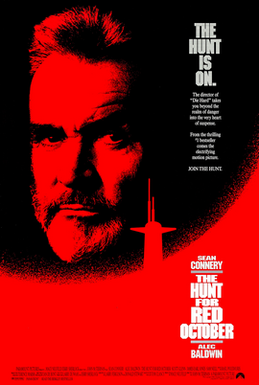
Tom Clancy Classics: The Hunt for Red October

(Yes, I know it's been over nine months since I wrote a blog post. That's a loooooong story. But here we have a new post, so...yay!)

Back in high school during the early 1990s, I started reading Tom Clancy's novels, and continued to do so into college, where I finally stopped when I tried reading The Bear and The Dragon, which was so gigantic a novel and so deeply entrenched in Clancy's fantasy universe (because by the time Clear and Present Danger came along, the series was no longer a "might be happening right now" and in the realm of pure speculative fiction) that I just had no interest, especially since this was right around 9/11 (aka, sixteen years ago). I haven't gone back to read any Clancy since then, but I found myself iin the mood after visiting Battleship Cove in southern Massachusetts, where they have the USS Massachusetts, as well as a destroyer, a submarine, and an East German missile frigate.

There will be spoilers ahead, since THFRO was published over thirty years ago, and the movie came out over a quarter-century ago. If you cared that much about spoilers for either, you'd have read/watched them by now. Also, I'm not going to write a synopsis - that's what Wikipedia is for.

First off, I love the THFRO movie. It has a great score, great acting by everyone, some excellent submarine combat scenes, and just an all-round great "techno-thriller" feel. I think that term, "techno-thriller" gets thrown around way too much lately, but THFRO is really one of the first novels to define the genre, and while the movie demonstrates some of the elements, it is in the novel where the elements of the Techno-Thriller really shine, because so much of the book's detail comes in not only Clancy's passion for technical precision, but in now military technology - both intelligence gathering tech and combat tech - plays a crucial role in the story. There's a whole scene around an Alfa-class Russian submarine suffering a reactor incident that, while extremely technically dense, creates a sense of impending dread in the reader as each aspect of the reactor failure is detailed, culminating in the fatal sinking of the submarine. While not everyone enjoys that level of detail, you have to admit that Clancy was very good at laying the details out and using them to ratchet up the tension of the story.

I've probably watched the movie ten times, but as this was the first time in probably 25 years I've re-read the novel, I was impressed with how much of the book has nothing to do with Ramius and Ryan. A lot more of the novel is given over to the standoff between the US and Soviet naval forces, something that is just touched upon in the movie where a Tomcat collides with a Russian plane and makes a crash landing on the carrier's flight deck. The novel really does a great job of showing the vast scope of the operation, from both sides.

Speaking of the opposing side, we have to discuss Captain Tupolev. In the novel, Tupolev is a former student of Ramius', but he goes after his old mentor out of duty, not some insane, bug-eyed obsession. Stellan Skarsgard was fine in his role, even if it was fairly limited, but the movie's Tupolev was a sweat-sheened, chain-smoking madman who would risk a reactor incident in order to catch and sink Ramius. The novel's Tupolev, at the end of the story, stumbles across Red October by accident, thinking it is an American Ohio-class missile submarine. You cheer Tupolev's death when you watch the movie, but I was actually sad to see him die in the novel, because it is clear he's rather conflicted, especially as in the novel, the submarine duel is three against one, no two against one as it is in the movie.

Other things of note?

In the movie, the fight with the saboteur takes place during the submarine battle, while they are separated by a couple of days in the novel. Ryan is also described in somewhat more unflattering terms in the book, a wealthy desk jockey with a bit of a paunch who was a second lieutenant in the Marines for three months (years in the movie) before being injured. Interestingly, the events that take place in PATRIOT GAMES are mentioned in brief in the novel, but not in the movie, which is interesting. I wonder as to the reason Clancy included that little side-note at all, unless he was already writing PG when finishing THFRO and decided to slip it in at the last minute.

In the novel, neither Jim Greer or Sonarman Jones are mentioned as being African-American. I think it was great that Hollywood (in a rare display) diversified the cast a little in picking two actors of color for those roles. Interestingly, though, there was a black submarine officer aboard the Dallas, who disappears (or isn't cast as such, I can't keep track of all those characters). So, the balance is really more like +1, instead of +2.

It's amazing how much of the novel gets cut away in order to make the movie. And the movie moves at a truly break-neck (no pun intended...) pace. There's also almost countless POV shifts, something that is a Clancy trademark in most of his novels, and something that many thriller readers and critics I know dislike - they prefer the story stick to the POV of just one character. As popular as he was, Clancy's stories and his writing style were not designed for the "average reader" in mind. You had to be able to keep track of many characters and be able to read, comprehend, and follow along with a lot of dense technical information.

Also, for a story that deals with so much cutting-edge technology, and still reads well 30+ years later, I did have to chuckle a bit when they start talking about computers, because their specs seem so antiquated now (I looked up the Cray-2 supercomputer that gets used in the novel - a 2012-era iPad is more powerful than the Cray-2). This isn't a fault of Clancy, of course, so much as it is a sign of just how far computing has come since the early 1980s.

Anyway, that's enough for now. Please feel free to leave any comments, and we can keep the discussion going!


Tuesday, November 22, 2016

Book Review: FINAL HARBOR by Harry Homewood

I never really thought that a novel following the action of a WW2 submarine crew would be interesting and exciting enough to keep my attention, but FINAL HARBOR proved me wrong. Not only is this book very well-written, the level of technical and historical detail is, in a word, staggering. In fact, if there are any complaints to be had about this book, it is that the little technical details occasionally get in the way because, while it may be proper protocol to repeat every command given, it doesn't need to really be written out that way!

But that is really about the only complaint I have regarding this book, and that complaint is relatively minor. The plot does occasionally stray into the domestic lives of the crew, but I think taken as a whole that isn't a bad thing, as it does tie us more strongly to the characters, and when there are casualties among the crew, the effect it has on the reader is a lot more pronounced. these aren't just cardboard cutout submariners firing torpedoes at the enemy and gritting their teeth while being depth charged, these are human beings with families and friendships, goals and aspirations.

As for the action itself, the scenes are extremely well written. Submarine warfare is very much winner-take-all, because even a single torpedo hit is capable of blowing a ship in half, while even one depth charge, if well-placed, is enough to shatter a submarine's hull and send her entire crew to the bottom of the ocean. Harry Homewood is able to deliver these scenes with nail-biting tension, and you come out on the other side with a sigh of relief, or a gasp of horror. Like war itself, this book does not pull its punches!

In conclusion, if you have any interest in WW2 submarine warfare, especially in the Pacific theater, I highly recommend this novel, and you can find it here on Amazon. There is a sequel, SILENT SEA, which I have read, and found equally engaging. Check them out!

Thursday, March 17, 2016

BOOK REVIEW: HAWKER #1 Florida Firefight by Randy Wayne White

Full disclosure: I was offered a free copy of this ebook by the publisher in exchange for a review. You can buy Florida Firefight on Amazon by following this link.

I'd never read any of the HAWKER novels back in the day, so the new ebook version was my first exposure to the series, which starts from a premise well-known to anyone who likes vigilante fiction from the '60s through the '80s. Courts are soft on crime, lawyers are all scumbags, and cops are either incompetent administrators gunning for a run on a political ticket in the future, or tough, hard-bitten streetwise crusaders trying to keep the criminal element in check, while constantly being undermined by "the system". Meanwhile, gangs of violent psychopaths and drug dealers roam the city streets like some kind of Tolkien-esque invasion of orcs and goblins.

Enter Hawker, a cop who doesn't play by the rules, blah blah blah. He kills a bad guy against orders and winds up resigning from the force, only to be hired by a reclusive millionaire to become a one-man vigilante army. You know the deal - the Punisher, but with better financing. To start the series off, Hawker goes to Mahogany Bay, a south Florida town where some Colombian drug-running bad guys are pushing around the townsfolk while using their land for smuggling purposes.

Hawker goes down there and purports to be the new owner of the Tarpon Inn, a formerly successful tourist spot which has definitely seen better days. He immediately gets into a fight with some of the Colombians and gets his butt kicked, but then beats up their leader and pulls a gun on them. He soon hooks up with a Native American woman named Winnie Tiger who is a biologist working in Mahogany Bay, and the only one who helps Hawker when he first encounters the Colombians. There is sexual tension from the get-go, and eventually they have sex. Of course.

I don't really need to give the shot-by-shot plot structure of the book - that's easy enough to find and it's a short book anyway, with a quick enough tempo that ensures an engaged reader will zip through it in a couple of evenings or a lazy Sunday. There's a good amount of gun porn and the violence is suitably visceral, with people getting shot, stabbed, punched, blown up, set on fire...even violated with an air tank and inflated to death (more on that later). While the body count isn't extreme, it is substantial enough to satisfy those whose primary reason for reading such fare is the satisfaction of punks and thugs getting their comeuppance.

And, to be fair, the plot did take me a bit by surprise. Hawker doesn't just go to Mahogany Bay and start slaughtering Colombians. Instead, he actually spends a couple of months in the town, working with the locals to bolster both their pride, and the town's economy. One of the more satisfying scenes in the book involves the townsfolk attacking the Colombians' stronghold and giving them a thorough whupping - sans killing, for the most part. Hawker had cautioned the locals against turning into killers, and there is an impressive amount of restraint and moral obligation there. Of course, even in the few moments where Hawker himself tries non-lethal means to deal with his foes, circumstances conveniently force him to proceed otherwise, and he does the lion's share of the killing in the book, aided by the Tarpon Inn's cook and bartender, both of whom are more than they appear.

I also really enjoyed Hawker using a (in 1984 terms) advanced computer system to track down information about the various players in the situation and gain an information advantage over them. Most of the protagonists in these books, if they do computerized information gathering at all, outsource that to some nerdish ally who is a "computer genius". While Hawker was trained by such a genius on how to do this, he does do it all himself, employing some convenient hacking software and an old-school phone modem to search various databases, even planting a false identity at one point to establish his cover. I hope this is something that continues throughout the series.

Unfortunately for readers in 2016, there are a lot of cringe-worthy parts in the book. Without exception, all of the "good guys" are white, while all of the "bad guys" are minorities. Even the alluring ("mystical" of course) Winnie Tiger is secretly in cahoots with the bad guys. There's one white German bodyguard of a bad guy, but Hawker hints that he thinks the guy is gay, calling him "...a candidate for AIDS disease.", a line that was so stunning, it took me a moment to even grasp its full, historical, implications. There's also a "hulking mulatto" named Simio (...really...?), given all the usual apelike descriptive portraiture, who likes to inflict pain as a strongman for the Big Bad Guy of the novel. Hawker kills him in a horrible fashion when Simio's pants split at the backseam during a fight, exposing his buttocks, and Hawker rams the nozzle of an air tank in Simio's backdoor and turns the valve, inflicting horrific trauma upon Simio's insides. I'm sure a Freudian could write a paper on that scene alone.

Setting aside racial and homophobic issues for gendered ones, there are four female characters in the book. Winnie Tiger, the mystical Indian woman who has sex with and then tries to kill Hawker, two large-breasted blondes who both die only after their shirts are ripped open to expose their assets in death, and Hawker's ex-wife, with whom he has dinner with before going to Florida, and who he almost, but I think does not, has sex with. She factors into about three or four pages of the book and is then completely irrelevant, making me wonder why she's even included except as a possible means to make Hawker seem more three-dimensional. Police Sergeant Dee Dee McCall (HUNTER television series, debuting the same year - 1984 - as this book) would not be impressed with the gender politics of Florida Firefight.

If you can get past these usual, rather uncomfortable artifacts (and if you made it past the first chapter, I'm sure you can), this is still a satisfying read for fans of such "serial vigilante" books. The ebook edition is well-formatted and there aren't any OCR typos that I noticed, typical for Open Road Media's products, which are usually very well done.

Friday, February 19, 2016

Book Review: THE ASSASSIN'S BETRAYAL by Mark Allen

I've known Mark Allen for a while now as a fellow author, blogger, and all-round action-adventure novel enthusiast. We've been corresponding back and forth for years, and we talked a lot about his planning of the sequel / not-sequel to his first full-length novel, THE ASSASSIN'S PRAYER, which came out a couple of years ago, and did pretty darn well. Mark liked how some things turned out, but in retrospect wished he'd done other things a little differently.

The result of all that experience and contemplation is THE ASSASSIN'S BETRAYAL, and I have to say, the wait was worth it. This story has everything that Mark pulled off to perfection in his first novel, and polished smooth any rough spots the first book might have had. There's action, there's sex, there's gunfights and swordplay, knives and chainsaws, welcoming dive bars and swimming pools filled with hungry sharks. In short, everything you need to tell an awesome, over-the-top-but-not-too-far action story, and make it a real page-turner.

And I say that last out of experience, because I downloaded the Kindle edition of the book late one night and read the first few pages before bed. Then next night, I picked up where I'd left off, and was so engrossed and caught up in the book's rapid-fire pacing, I stayed up well past one o'clock in the morning because I literally couldn't make myself put the book down and go to sleep - I knew I'd just lie there awake, wondering what was going to happen next.

So, if you're into the modern action-thriller genre, dig assassins and gunplay and a book with a significant body count, you cannot go wrong with THE ASSASSIN'S BETRAYAL. Pick it up!

Thursday, February 11, 2016

Book Review: KILL ZONE by Zeke Mitchell

I must admit to feeling rather conflicted about this book. Author Zeke Mitchell clearly loves the "Men's Adventure" genre of fiction made so popular in the '60s through the '80s, as well as '80s action movies such as COBRA or INVASION U.S.A., and every ounce of that love was poured into writing this book. There are a bunch of direct and indirect references, both in tone and otherwise, that show the intent of making Kill Zone a child of its inspiration.

On the other hand, I think this diamond is still just a little too rough. While the author is able to craft a solid action sequence, and the overall plot of the book flows well enough as a series of action set pieces, I think the story definitely needed some more constructive criticism. I'll give a rundown in no particular order of importance:

- The term "kill zone" appears in the body of the book thirty-eight times. While using the title of one's work in the body of said work is fine in a rock ballad, in a novel it is generally frowned upon, and while once or twice is fine (that, "Okay, I get it" moment), several dozen instances are way too many, and immediately jar the reader out of the narrative. After finding multiple uses in the first chapter, I stopped reading to use the Kindle search feature - which gave me the total. If I am that distracted by the over-use of the term to stop reading and do a word search, this is a problem.

- I understand the desire to make the character a lone hero. Many of the best protagonists of the genre are "lone wolves", but when you pay attention to the books and movies in question, the protagonist is always interacting and balanced by a host of secondary, supporting characters. In this book, aside from "interacting" with bad guys by riddling them with bullets, Thorn only makes a couple of phone calls and delivers one or two extremely short bits of interactive dialogue. Without someone to play off against, either a partner or a recurring antagonist, we spend way too much time just reading Thorn's own inner monologue, which got somewhat tedious, especially during the more fast-paced combat sequences. The author really should have just focused on the action-reaction-action-reaction of the fights, rather than the repeated running mental commentary in Thorn's head, which slowed the pace of the text down somewhat.

- The author's writing style isn't going to work for everyone. Many short, clipped sentences, as well as paragraphs separated by other "paragraphs" of extremely short sentences, or even single-word paragraphs. While this device is good for demonstrating a pivotal moment, it's repetition throughout the novel weakens the impact of the device when it is needed most.

- Although it is just playing to the source material, I thought the idea that the government would send a single man - albeit highly successful and well-trained - to dismantle through violence a criminal empire responsible for a *global* drug epidemic a little far-fetched. Yes, I know, the one-man army trope is a classic one, but I feel the hyperbolic nature of the story was a little extreme, especially as this is the first book in the series. I feel like now, there isn't a lot of leverage to up the ante in subsequent stories. This complaint is just personal preference, but I would rather have seen a smaller, more "street level" story - perhaps Thorn being sent to nip in the bud a drug kingpin right on the verge of making it big, rather than one whose drugs are causing a global catastrophe affecting millions upon millions of lives.

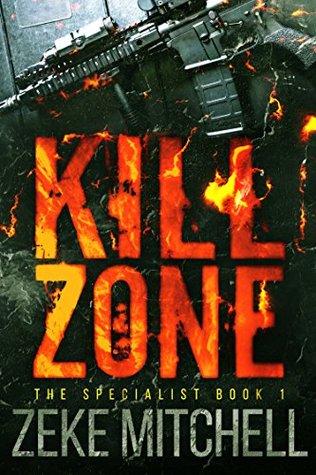
All the above being said, I still enjoyed the book a lot. Technically, the ebook was well-formatted, and I only caught a couple of very minor typos, of the sort that always slip through no manner how carefully a book is proofread. The book's cover is absolutely superb, and no doubt has caught the eye of many of the book's buyers, leading to that "one-click" impulse buy, as does the short but very evocative product description. As of right now, Kill Zone's Amazon book ranking is hovering a little above 2,000 in the Kindle Store, which is extremely good for a debut indie novel.

In conclusion, if you're the sort who enjoys '80s action movies starring Chuck Norris, Sylvester Stallone, et al, as well as serial Men's Adventure novels like The Executioner, Able Team, The Death Merchant, and so forth, I think you'll enjoy this book, and you can pick it up on Amazon by clicking here.. There's a ton of action right from the get-go involving fast cars, big guns, explosions, knives to the face, flamethrowers, rocket launchers, more explosions, people's heads being blown off, even bigger guns, and a couple more explosions. While I have been somewhat critical above, I hope the author doesn't take it as discouragement from writing more books in this series, but rather as helpful feedback.

Wednesday, November 4, 2015

Book Review: TIGER TRACKS and THE LAST PANTHER by Wolfgang Faust

A very common phenomenon in the vague, sweeping genre of "war memoirs" is the false memoir, especially the false World War Two memoir, purported to be written by (most often, I've found) German soldiers and either lost or "published now for the first time" decades after the war. WW2 fiction and/or greatly embellished memoirs of wartime sold rather well among certain demographics, and even today - as I myself can attest - new WW2 fiction is popular among readers. So it is natural that, even now, false or at least dubious memoirs of the war are being "re-published" as ebooks. The "StuG Command" book I reviewed about a year ago was a perfect example of this, a story I am entirely certain is a complete fabrication (and not really that great a book, either).

I found TIGER TRACKS and THE LAST PANTHER a couple of months ago, and bought both for my Kindle. I recently read the two of them back to back - they're both fairly short reads, probably around 25-30,000 words apiece - and I have to say, they were pretty enjoyable. I don't believe for a second that Wolfgang Faust is a real person, or that the name is even a pseudonym of a real person, but I have to admit that the story reads well, albeit rather over-the-top in terms of the lurid violence and misery. The two stories cover different periods of time during Faust's career; TIGER TRACKS takes place in 1943, while THE LAST PANTHER takes place in April of 1945, right at the very end of the war.

Of the two, TIGER TRACKS (available here on Amazon) is probably the weaker story. Faust's unit of twenty Tiger heavy tanks is assigned to take some hill from the Soviets. The fight is bloody and several Tigers are immediately taken out of the fight, but in the end, the Germans defeat the Soviets and take the enemy position. However, the reinforcements that were originally promised never arrive, and they are forced to retreat, after capturing a Soviet female radio operator. The Tiger force is constantly harassed by Soviet attacks, encountering enemy armor, infantry, air attack, artillery, and even a particularly terrifying ambush by a flamethrower team. Whoever Wolfgang Faust really is, the writer is quite good at depicting the absolute horror of mechanized warfare. In particular, Faust is good at showing how the Tiger might be a very tough tank, but it is far from indestructible. Tigers are destroyed by hits from enemy anti-tank guns and other tanks, cracked open by air attacks, set ablaze by flamethrowers or Molotov cocktails - the list goes on and on. He also points out that a tank is not designed to drive everywhere under its own power - it requires tank carriers or rail transports, and must receive constant maintenance. Faust, as the Tiger's driver, is in charge of the mechanical care of the tank, and he is constantly worrying about the bogie wheels, the track links, the transmission and all other aspects of the fighting vehicle, because he knows that no matter how strong their armor, or powerful their gun, all it takes is one broken track link pin to immobilize the panzer and doom them.

On the other hand, the story kind of rambles. After their mission, Faust's tank commander (who is now in charge of what's left of the force) decides they need to bring the Soviet radio operator back for interrogation. So they set off for the rear lines, and the story just becomes a series of harrowing vignettes, until they reach their destination. There's no real drama, other than the need to get back to the rear echelon area, and even when that happens, the ending is a bit flat. I'm willing to forgive that, though, because the action throughout the story is still, in my opinion, rather top notch. As fun as the PANZER PLATOON series is (and I'll write more reviews of it later on), the combat scenes in these two books are far superior.

THE LAST PANTHER (available here on Amazon) is the better story of the two, mostly because it has a clear end-goal, and works to ratchet up the tension in getting you there, and the end of the story carries a lot more weight and pathos. In addition, the story revolves around an actual historical event, the "Halbe Kessel" or Battle of Halbe, a week-long retreat by German forces attempting to flee West and surrender to the Americans, rather than be captured (and probably killed or sent to a gulag) by the Soviets. Faust is, by 1945, a Panther panzer commander, and is tank is one of the few remaining in good condition within the group of German soldiers and civilians fleeing the oncoming Soviet army. They know they have to cross the Elbe river, where on the other side the US Army is waiting, but the Soviets are not only to the East, but essentially all around them, slowly closing in and crushing them.

THE LAST PANTHER is definitely more intense than Faust's first story. The inclusion of German civilians, who all know their fate in the hands of the Soviets pretty much involves rape, murder, or (likely) both, definitely makes for much stronger tension over the course of the novel. Women and children die in great numbers as the Soviets attack their column over and over again. The Germans, especially the panzer forces, do what they can to protect the civilians, but they can only do so much, especially as their vehicles keep breaking down, getting stuck, or destroyed by the enemy. Faust is constantly terrified that his Panther's engine will die, because he knows the engine is only good for about 800 kilometers, and at the start of the novel, they're already pushing 900. Fuel is also a big concern, and they're constantly on the lookout for more gasoline, usually taken from broken-down vehicles.

But the story also involves a lot more in-fighting and social tension, between the regular Wehrmacht troops, the Waffen-SS forces, and the civilians. Some of the SS are fanatics, to the point of killing Germans who do not stand and fight, while others are cowards who shed their uniforms and try to hide as civilians because they know the Soviets will give SS men no mercy. The worst-fated of all are the Soviets who are prisoners of the Germans and serve as laborers, because they know their own countrymen will kill them - and probably their families back home - if they're ever captured, but they're the Germans' lowest priority in terms of ensuring those in the Kessel escape the encirclement. Historically, only about 30,000 people - a mere fifth of those attempting the breakout - successfully escaped, so you can imagine the scale of slaughter that takes place in this book. There's on scene in particular, as the column tries to punch through a German village as they're being savaged by a Soviet bombardment, which is particularly awful, but by no means is it the only scene of massed slaughter.

Like TIGER TRACKS, this second book features some really solid, tensely-written combat scenes, and Faust is very good at portraying the various fighting vehicles in something approximating their historical strengths. The Panther was an excellent tank, with a main gun capable of defeating any tank in the world at that time, and very thick, sloped frontal armor that was probably the equivalent, if not superior to, the Tiger's frontal protection. However, the Panther was a smaller, lighter, faster tank, making it more maneuverable and not quite so mechanically fragile (although like all the late-war Panzers, it did break down in great numbers). There are also some good scenes involving King Tigers, Hetzer tank destroyers, and other German vehicles which added to the flavor of the combats.

All in all, these two books are relatively inexpensive ebook reads, fairly short by novel standards but fast-moving and filled with action. They both get relatively good reviews on Amazon (although a fair number of low reviews, mostly complaining about them being "false memoirs"), and they both seem to be selling quite well. If you're a fan of WW2 action-adventure fiction, I highly recommend reading both of them - I don't think you'll be disappointed.

Monday, August 10, 2015

Book Review: PANZER PLATOON #2 - INVADE RUSSIA! by Gunther Lutz

The second in this six-volume series kicks off a short time after the invasion of Russia by the German army in the summer of 1941. Rather than their lightweight Panzer II, this time Micki Boden and his crew are operating a Panzer III, one of the mid-war models with a short-barreled 50mm anti-tank gun. The extra crew members are characters we were introduced to in the first book, as coming from one of the other Panzer IIs in Boden's platoon.

Like the first book in the series (and most of the books, as I've now read the first four of the six as of this review), there is no real overarching plot to each book. Rather, the novels are a series of vignettes tightly tied together, providing a good representation of whatever is occurring in that theater of operation at the time. In this case, Boden and his crew are involved in Operation Barbarossa, during the operation's heyday from summer to fall of 1941, before the brutal winter sets in and the German advance is stopped.

For the most part, Boden and his panzer crew encounter relatively little resistance from the Russians, and their biggest problems are the over-stretched supply lines, coupled with a new platoon commander who proves to be a constant nuisance to Boden and the rest of the platoon. This new commander isn't a veteran of the '39 or '40 campaigns, and so lacks the necessary combat experience to lead a platoon, especially as the panzers wander further and further afield. This becomes especially problematic when one of Boden's crew is injured, and they have to seek medical aid from a local Russian doctor. Food also becomes an issue, as they've ranged so far ahead that the "goulash cannon" (field food service units) are nowhere to be found and they must forage locally for their rations.

Throughout the book, there are many hints as to how the entire Russian campaign is a bad, bad idea. Early on, Boden's crew discovers an intact panzer...but the five-man crew is dead, each man decapitated, their bodies left in their proper positions inside the tank, their heads put on display outside the hamlet where they parked, probably to also forage or rest for the night. This gruesome display puts Boden's men on edge, because it hints at the savagery the Russians are capable of, and how tenacious a foe they can be if given a chance. Later on in the book, Boden joins in defending a position against a Russian counter-attack, one that is bolstered by the deadly Russian T-34 medium tank. The T-34 outclasses the Panzer III of the time in almost every respect - main gun, armor, and mobility - and they're the boogeymen of the Russian battlefield. The climax of the book is a tank duel between Boden and the rest of his platoon against several T-34s in an abandoned factory, and it is a tense, exciting scene where clever tactics and luck face off against far superior Russian tank design.

This book is definitely an excellent sequel to BLITZKRIEG, and gives the reader what they really wanted from a series called "Panzer Platoon" - battles between tanks which are roughly equivalent to each other. The action is well-written and shows how careful and analytical a panzer commander needs to be in order to survive on the battlefield, and as mentioned, this book does a great job at hinting towards the horrors of the "Ostfront" (which we see in full force in the next volume, BLOOD & ICE).


Monday, August 3, 2015

Book Review: PANZER PLATOON #1 - BLITZKRIEG by Gunther Lutz

Sorry, Tiger tank - wrong year!
The PANZER PLATOON series is a six-book run of WW2 stories told from the perspective of a German tank commander. The series was written through the late '70s and published by Sphere Books, a UK paperback publisher. The author, "Gunther Lutz", is probably a pseudonym, and I am following some leads to track down the author's real name.

The first book in the series, BLITZKRIEG, follows Micki Boden, an Unteroffizier commanding a Panzer II light tank. What exactly Boden's rank is gets kind of muddled - sometimes he is referred to as a corporal, but the rank could be higher than that. Boden is in charge of two men, his driver and his loader / radio operator, and we know at least Boden and his driver were in the Polish campaign of 1939. The loader/operator is a Nazi fanatic, always going on with party slogans and ideology, and it is made clear that Boden considers himself a soldier first, but he rolls his eyes and actively makes fun of his loader/operator for the young man's fanaticism. I feel like this is a requirement of every German protagonist in WW2 fiction - he's just doing his duty for his country, not one of Hitler's goose-stepping puppets! At the very least, it lets you sympathize with him more, since you're not just chomping at the bit, waiting for Boden to get vaporized by a howitzer shell.

The story itself is essentially a series of vignettes, as Boden and his crew make the race to the French coast. The French and British forces are collapsing faster than the Germans can advance, and Boden's tank platoon finds itself often just passing by wrecked or abandoned Allied equipment, often destroyed by airstrikes. His first action in the book is to support a company of assault pioneers as they take a French bunker. This assignment separates Boden's tank from the rest of his platoon and the regiment, and most of the book is spent trying to catch up with their unit, which allows for some smaller-scale battles, pitting Boden and whatever band of Germans they come across against some token French or British forces.

The action in this book is pretty well-written, and the author largely knows his technical details, although there are a couple of glitches here or there. A common editing mistake in this book is that the author sometimes mis-types "cm" and "mm" for weapons, so he'll reference a "20cm" anti-aircraft gun which is no doubt the German 20mm AA autocannon, and this sort of thing happens a few more times throughout the book. In my experience, Germans tend to refer to their weapons by centimeter caliber, while the British refer to them by millimeters, so I think the author just never quite figured out which he wanted to use and there was the resulting mixup. There are a couple of other minor details that he gets wrong - for example, the KwK 30 autocannon in his Panzer II can fire both armor-piercing and high explosive ammunition, but the author states in the book on a couple of occasions that it can only fire AP. Whatever - it doesn't really matter, and there's a lot of other good information to make up for a couple of small mistakes.

There are several tank duels between Boden's Panzer II - a very light tank, more equivalent to an armored car than what we'd consider a real frontline tank - and both French and English tanks. Each scene is very tense, and the author does a good job of showing Boden's tactical prowess, maneuvering and picking just the right ground to fight from and the right moment to attack to make best use of his limited firepower. Those not so aware of German panzer history might not know it, but in the first few years of WW2, the majority of Germany's panzer inventory were light tanks, inferior in armor and firepower to the enemies they faced off against. It was their superior tactics, communication, and supporting elements that gave the panzers their victories. This is very well illustrated throughout the course of the novel.

Overall, I really enjoyed BLITZKRIEG. I was concerned going into the book that it was going to be a lot worse than it was, and although there are some cheesy interludes here and there (2 1/2 books into the series now, I see that the author likes having his characters encounter women during their downtime, with the usual "mature content" results), overall these books feel very gritty and unglamorous. A lot of men die very brutal, pointless deaths, and the survivors must carry on and do their duty no matter what.

These books were not particularly cheap to come by (I think I paid $10 for this book, not including shipping), but if you like WW2 fiction written at the height of the British War-Lit era of the 60s through early 80s, I think you'll enjoy the PANZER PLATOON series.

Thursday, July 23, 2015

Book Review: THE GLASSHOUSE GANG by Gordon Landsborough

When I first became interested in this series, I assumed it was another Dirty Dozen ripoff - a team of convicts who are recruited by some semi-mysterious Intelligence Officer and offered the chance of a clean slate in order to take on some (no doubt near-suicidal) Commando-esque mission. This was the basic plot of the Destroyers/Dirty Devils series (see previous reviews of books 1 and 4 below), and there is of course no reason multiple series using the same basic plot premise couldn't be written (see also: every ripoff of The Executioner...).

However, Gordon Landsborough's THE GLASSHOUSE GANG is quite different from the expected plot-line. The story instead revolves around a band of British military prisoners, who've been busted for a variety of crimes - some minor, some completely reprehensible - and are serving time in the notorious (but as best as I can tell, completely fictional) Sharafim Prison in Egypt. The prison is run by officers and staff sergeants who are, at best, criminally lax in maintaining humane conditions at the prison, and are, at worst, vicious sadists who take great pleasure in beating and torturing their charges to within an inch of their lives - and occasionally beyond.

The first scene of the book is just such an example of two "staffs" brutally tormenting John Offer, the main character. Offer was formerly a Territorial Army quartermaster's sergeant, whose black-market dealings caused him to go on the run. He joins the Regular Army under an assumed name and becomes a lieutenant, but gets recognized by someone from his TA days, and Offer eventually gets busted because of it, demoted to private and sent to the "Glasshouse", slang for prison. Being a former officer (even a false one), Offer is constantly beaten and tormented by the staff sergeants who work there, and when he is finally released, Offer decides that something needs to be done to settle the score against the non-coms and officers who run the prison system.

One interesting aspect of Offer's background is that he was originally a stage actor, and once released from prison, Offer puts this background into good use. He gets a local tailor to make him a Captain's uniform, "requisitions" a lorry for his own use, and begins to find and recruit men from the Glasshouse he can trust as they are eventually let out after their sentences are over. Using the power of his assumed role and a cadre of men around him to reinforce the legitimacy of his ruse, Offer and his "Glasshouse Gang" spend the first third of the book slowly building up their numbers, acquiring resources, and taking revenge on a few of the "Screws" (prison guards) who were especially vicious to them.

The second third of the book involves Offer and his G.G.C.U. (Glasshouse Gang Commando Unit) executing a prison break, where they free a couple dozen prisoners from Sharafim, and then set up their temporary camp on the edge of the city, where they feast on stolen food and get drunk off of stolen liquor. Eventually these good times end, and the G.G.C.U. flees the law, taking off into the deep desert and eventually arriving at the Siwa Oasis...just as the Germans are attacking and driving the LRDG (the Long Range Desert Group, a unit of deep desert recon men in the British army) out of Siwa. Offer's gang holes up in a grove on the edge of the Oasis for a few weeks, until they discover some of their men (who they thought dead) as well as some LRDG men, in an outdoor prison encampment in Siwa. The last third of the book involves Offer and his men planning and executing the rescue of these prisoners.

All in all, this was actually a very entertaining read. John Offer reminds me a lot of Colonel John "Hannibal" Smith from the A-Team - a leader who thinks unconventionally and fights dirty when he's forced to fight at all. There's not a lot of action in the book in the traditional military sense, but what there is, is written well and maintains a brisk, exciting pace. The rest of the characters are amusing and flesh out the story nicely, especially the conflict between Offer and McTone, one of the more dastardly prisoners who joins the G.G.C.U. during the Sharafim jailbreak.

I can understand why the series only went four books - it's not really the sort of story that lends itself to a long run without becoming repetitive - but I quite enjoyed the first novel, and as I have acquired the other four books, plan on reading them and reviewing the titles here. If you want British WW2 adventure fare that's a little different, do your best to find and read THE GLASSHOUSE GANG.