Showing posts with label movie reviews. Show all posts

Monday, September 23, 2019

Media Monday: Rambo V - Last Blood

There's no good way to approach a review of this without sinking neck-deep into the current socio-political quagmire. There just isn't. I'm going to do my best to talk about it without engaging this, but I will fail. I'm just putting it out there that this review isn't meant to be a discussion of racism and politics in film, but rather, how to handle such issues in a way that doesn't make you look like a pack of morons.

Rambo: Last Blood is a garbage movie. There, I said it. Bring on the hate. I grew up watching the Rambo movies on VHS and (edited) television channels, so if someone wants to accuse me of not loving mindless action movies, come at me, bro. I saw Rambo 4 in the theater and left absolutely thrumming with adrenaline because I thought it was, if not a masterpiece, certainly leagues better than Rambo 3, and felt like they at least put some effort into addressing the complexities of the issues at hand with how outsiders view violent civil conflicts, and the futility of "helping" in regions where such help is marginal at best, and bloodily counter-productive at worst.

Last Blood, on the other hand, appears to have been conceived for the sole purpose of getting to the last 20 minutes of the film, and no one gave any real thought or care as to how the film got there. In order to talk about this, I'm going to have to deal with some extensive plot spoilers, so now is your chance to bail now if you don't want this.

Keep scrolling.

Almost there.

A little more.

Last chance.

Okay then, don't blame me if you're reading this and don't want spoilers.

The long and the short of it is that Rambo is now living on a horse ranch in Arizona with Maria, a woman who is at least approximate to his age, and Gabriela, a young girl who is graduating from high school and going off to college. The first big problem here is that Rambo's relationship to these two women is never actually explained. At the end of Rambo 4, you see Rambo going to a place that you assume is his family farm, but in this movie, you don't really know who is related to whom. Rambo isn't Gabriela's father, or even her grandfather. There's mention of her mother, and a deadbeat dad, whom Rambo stopped apparently at one point from beating up the mother. I'm not even sure of the relationship between Maria and the younger girl - I think she might be an aunt, but I can't say for sure. Seeing as the film spends at least its first 20-25 minutes establishing the family dynamic, the fact that I couldn't figure out the relationships makes this just sloppy writing. This is especially annoying, because the entire reason Rambo goes so batshit later on is that the girl is so emotionally important to him, the "one good thing in his life".

OK, according to Wikipedia, Rambo has no relationship to any of these people. The horse ranch belonged to his dead father, and Maria is the grandmother to Gabriela, and Maria just...runs the household? That at least makes sense, but this relationship isn't really ever laid out clearly, which shouldn't be that hard. You at least know that Gabriela's mother died of cancer when she was little, and after that, her father - who was apparently always an asshole - leaves her with Maria and goes off to Mexico. Fast forward to now, when Maria is 18. A childhood friend of hers - Gizelle, who is referred to as a "bad girl" by Maria - is now living in Mexico, and she has found Gabriela's father, who apparently lives in the same Mexican town. Despite Rambo and Maria repeatedly telling her that her dad Miguel was a violent asshole and she shouldn't have anything to do with him, and Rambo even telling her that she should maybe let her urge to visit her father simmer a little before she makes the decision to visit him, Gabriela almost immediately ducks out and drives down to Mexico to go find Gizelle and her father.

I've already spent two long paragraphs here, so I'll keep this short. Dad is an asshole (surprise) and tells Gabriela to beat it. Gabriela is sad, Gizelle takes her to a club, where she sells (!!!!!!) Gabriela to some sex traffickers, who then drug and kidnap Gabriela. Gizelle then calls back to Maria, tells her she lost Gabriela, and Rambo goes full batshit mode and drives down to Mexico, where he finds Gizelle, realizes she sold out Gabriela, and gets her to point out one of the bad guys. Stuff happens, Rambo fails, and gets beat up by the rest of the bad guys, who decide not to kill Rambo, a guy who just tortured one of their own, and showed up with a pistol and a knife.

Gabriela gets doped up, gets her face slashed, and is put to work as a forced prostitute. Eventually Rambo learns from an "independent journalist" (who just happens to watch him torture one of the bad guys and saves him after his beating) where to find Gabriela, but alas, after he saves her, she dies in his car as they're just...I don't know, driving around in the dark. Yes it makes no sense. He finally drives over the border and brings her body home, then buries her on the farm. Maria just packs up and leaves. Rambo tells her he's going to leave too, but that's a lie. He goes back to Mexico and kills one of the two lead bad guys in a way so that they know it was him. He then comes back home, preps his murder maze, and in the last 20 minutes of the film, kills everyone. The end.

You might be thinking, "Hey, this actually sounds awesome, what's the problem?" but honestly, everything is just so stupid. It's not that the characters make stupid decisions - although there is some of that - but that every time the story reaches a point where something could be done in an interesting, intelligent, nuanced fashion, the car screeches off the road and goes into the ditch. By the time you get to the climactic battle at the end, it is boorishly obvious that the entire reason the film was made was to show Rambo running around an underground death maze, murdering bad guys with knives, punji sticks, old-timey guns, booby traps, and other assorted ordnance (claymore mines and hand grenades???). There isn't even any strategy or cleverness to any of it - bad guys just die, over and over, running flat-out into death and screaming in blood and pain.

I'm sure many of you are STILL shaking your heads and saying, hey, what's the problem? The problem is, it is stupid, sloppy work. This movie could have been a really good reflection on the plight of old soldiers who never really left the war behind. On PTSD and re-integration, on wanting to be left alone, only to find violence at one's doorstep again. And while you might think there's some of this, the movie only ever skims the surface, like a stone skipping across the water, but never sinking, just bouncing back out on the other side of the river. What was the point of the movie? What themes does it dig into? What message does it send? You could get the same thrill just firing up your XBox and killing dudes in some FPS game for a couple of hours.

And yes, I am skirting the whole "Mexico" issue. The only thing I'll say about that is, you could have told the exact same kind of story, even with most of the major plot elements relatively intact - and not use Mexico as this sort of Hades-esque underworld that you only venture into at your own risk. It is, again, sloppy, tone-deaf plotting that so obviously doesn't care how it is going to be received, and in fact is probably counting on "snowflakes" hating the movie to stir up buzz and get defensive butts in seats in support of the movie. I don't know, and that's not something I want to engage with, but again - there were many directions the movie-makers could have taken this story and at the same time, left its bones intact. They picked a route through some really, really questionable waters, and at the same time, made a film so sloppy and superficial that there's no real substance to back up the choices they made, except to get us to the finale with extreme prejudice.

Honestly, I am really disappointed.

Monday, August 26, 2019

Media Monday: Death Kiss

A bit of a brief post today, as I'm in what's typically the busiest week of the year at work. If you've been around this blog for any amount of time, you know my fascination with the DEATH WISH series, both the two books written by Brian Garfield, as well as the *five* movies made starring Charles Bronson. And of course, it's no secret that much of my fiction writing is inspired by the notion of the urban vigilante.

So I was definitely curious when the micro-budget crime movie DEATH KISS came onto the scene. Basically, you can treat it as an unauthorized, unofficial follow-up to the Death Wish film franchise, although that is never truly acknowledged. Death Kiss is available on Amazon Prime Video, and you can check out the trailer here:


Just as interesting as the movie (and perhaps for some people, even more so), pulp aficionado Bill Cunningham of Pulp 2.0 Press has written a book that does a great job of breaking down the production and marketing of Death Kiss from a business perspective.  Allow me to quote my review of his book Death Kiss - the Book of the Movie, here:

To preface, I have seen DEATH KISS and read through Cunningham's dissection of the film, and I write this review from the point of view of a novelist and storyteller, as well as someone who went through film school in the late 1990s, when low-budget independent film-making was on the mind of many of my fellow classmates. I am also a huge fan of Brian Garfield's original DEATH WISH novel, as well as the 1974 adaptation by Michael Winner. I've put out articles about vigilante storytelling, and have written a bit of it myself.

I say all this because the idea of an indie project designed specifically to tap into that Garfield/Bronson/Winner-inspired vigilante crime story market was immediately appealing to me. I watched the film DEATH KISS before reading the "Cinexploits!" case study, and while there were portions of the film that I might have criticisms about, I think overall, with the resources available to the director, the overall final product was entertaining - I honestly enjoyed it more than the 2018 remake with Bruce Willis!

And so, having seen the film, I decided to read the DEATH KISS case study. It is an excellent breakdown of the idea behind the film, and how so often in the entertainment industry, the people you know and the connections you make - both "above the line" and below - can make or break the project before it even goes into production. The relationship between Rene Perez and Robert Kovacs - a man with, shall we say, a particular set of skills - allowed the idea of a DEATH WISH-styled independent film to grow from the seed of an idea into a full-bloomed production.

Further, and this is something I especially take to heart as a novelist, Cunningham takes a lot of time to discuss the pragmatic, commercial, *business* of film-making - about making sure that your idea isn't just a good story, but that it is a story you can *sell*, and knowing what markets would be best for your idea, and making sure that you are delivering a product that fits with those markets. Artistic storytelling for the sake of storytelling is a noble concept, but it doesn't pay the rent or the talent. If you are in the *business* of film-making, you must understand first and foremost that your business is commercial in nature, and that you must, above all else, make money from the sale of your product. Period.

Of special note is the breakdown of the ARKOFF Formula. I won't go into the details here, but it is a point-by-point process epitomized by the methodology of Samuel Z. Arkoff, who did great business during the second half of the 20th century producing and distributing commercial theatrical films. I find the ARKOFF Formula worth studying by anyone who has an interest in storytelling designed to - first and foremost - get people to part with their money.

As this review is already fairly lengthy, I will end it by pointing out that the book also includes the DEATH KISS script, as well as a lot of great details about low-budget film production. As part of my day job I regularly interact with faculty and staff that support student film-making, and I have been in many a meeting where people argue for the best film cameras and the best lenses and the most expensive NLE hardware builds and finishing spaces. While more money and resources usually doesn't *hurt*, it often puts people in the mindset that more money is the answer to the practical problems they face during production. However, you don't tell a better story because you don't have the most expensive lens, or because you're only shooting in 1080 vs. 4K. Good stories are still good stories, even if they are produced on non-Hollywood grade production equipment. It is skill, talent, and ingenuity that tells great stories, not the most expensive ARRI rig you can get from a rental house.

If you have an interest in independent film-making, commercial storytelling, or even just the idea of taking a 1970s cult hit and using its gravity to slingshot an idea forty years later, I highly recommend you get your hands on DEATH KISS: The Book of the Movie.
So if you are a fan of low-budget film-making, a fan of vigilante action, or a blend of both, check out both the movie and the book.

Monday, August 19, 2019

Media Monday: War Fever (1969)

Today I'm starting a new push towards regular blogging, and with that, a Monday post every week about some kind of media - film, television, comics, or artwork. Today, I am featuring a film I watched a little while ago on Amazon Prime video, where it is labeled "Salt in the Wound", but the film also has the titles "War Fever", "The Liberators", and its original title in Italian, "Il dito nella piaga", which, according to Google translate (for whatever that's worth) means "The Finger in the Wound".


The plot revolves around Corporal Haskins and Private Greyson, two US Army soldiers who have been accused of crimes (IIRC in both cases, they did commit those crimes), and are sentenced via court martial to death by firing squad. The firing squad detail is led by a shiny new second lieutenant named Sheppard. The two doomed men are driven out to an isolated spot to be executed, but Sheppard gets the directions wrong, and they wind up off the beaten trail. The detail is discovered by a German patrol, and everyone but Haskins, Greyson, and Sheppard is killed. The two convicted men and their executioner flee into the wilderness, armed but ill-equipped, and that's when the movie really begins to pick up.

The dynamic is clear from the beginning. Haskins is a corporal but he's significantly older and more war-weary than Sheppard, who has just come from State-side and has never been in combat before. Greyson is a black man in a white man's army and feels his own bitter resentment towards how he has been treated, and for the first half of the film, he's still in a state of shock, which unfortunately doesn't give the actor much to work with and does a bit of disservice to the character. But Haskins, played by the utterly fantastic Klaus Kinski, sneers and laughs and taunts Sheppard, all the while keeping a Thompson submachine gun pointing Sheppard's way. Haskins doesn't have it in him to kill Sheppard outright, even though he could, and doing so would essentially make him and Greyson free men since there would be no Allied soldier alive who'd know the two doomed men were still living.

When the trio stumble across a small Italian town, there is some rejoicing, as the locals think the Americans are just the lead element in a much larger force sent to "liberate" their town. There are hints of Kipling's "The Man Who Would be King" here, as Haskins soaks up all the glory and warm treatment he can get, playing up his fake role to the hilt, while Sheppard stumbles through the occasion, trying to keep the Italians' expectations realistic, while at the same time, trying to be diplomatic and polite. Greyson, an object of curiosity as the first black man many of the Italians have ever seen, is treated well enough, but it isn't until he befriends a young boy that his character begins to really open up and is given a chance to have significant dialogue and emotion. And of course, there is the extremely cringe-worthy "romance" between Haskins and a young Italiam woman that he relentlessly pursues, in a manner so aggressive that I honestly found myself physically recoiling from the screen at his advances. This is flat-out the worst part of the film.

Of course, inevitably the war comes to the small town, as the Germans have decided it is a good place to defend themselves against an advancing American front. They send an element to capture the town, and soon, Haskins, Greyson, and Sheppard find themselves having to defend the town from the attacking Germans. For a bottom-of -the-budget-barrel film, the combat scenes are actually quite well done, uncompromising in the violence, and while the editing is done in large part to hide the lack of a budget, you can easily follow the action. I won't give away the ending, but let us just say that all sides pay a steep price by the end of the film.

Looks like you can watch the full 97-minute cut of "Salt in the Wound" here at YouTube:


Overall, I enjoyed this a lot more than I expected. Despite its extremely small budget, including weapon props that are quite obviously non-guns in many scenes, I liked the story of a pair of soldier-criminals who are doing everything they can to avoid the war, but wind up finding themselves fighting for the lives of civilians they barely know. I also enjoyed the dynamic between Sheppard and Haskins, even though much of it was over the top, due in a large part to Kinski's sneering visage. Also, I believe that I read somewhere this film was the inspiration for the original The Inglorious Bastards made in 1978 (*not* the Tarantio movie of a similar name but different spelling), which involves a group of American soldiers who are criminals, being sent on a "suicide mission".


Monday, September 11, 2017

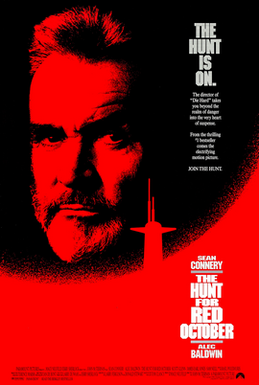
Tom Clancy Classics: The Hunt for Red October

(Yes, I know it's been over nine months since I wrote a blog post. That's a loooooong story. But here we have a new post, so...yay!)

Back in high school during the early 1990s, I started reading Tom Clancy's novels, and continued to do so into college, where I finally stopped when I tried reading The Bear and The Dragon, which was so gigantic a novel and so deeply entrenched in Clancy's fantasy universe (because by the time Clear and Present Danger came along, the series was no longer a "might be happening right now" and in the realm of pure speculative fiction) that I just had no interest, especially since this was right around 9/11 (aka, sixteen years ago). I haven't gone back to read any Clancy since then, but I found myself iin the mood after visiting Battleship Cove in southern Massachusetts, where they have the USS Massachusetts, as well as a destroyer, a submarine, and an East German missile frigate.

There will be spoilers ahead, since THFRO was published over thirty years ago, and the movie came out over a quarter-century ago. If you cared that much about spoilers for either, you'd have read/watched them by now. Also, I'm not going to write a synopsis - that's what Wikipedia is for.

First off, I love the THFRO movie. It has a great score, great acting by everyone, some excellent submarine combat scenes, and just an all-round great "techno-thriller" feel. I think that term, "techno-thriller" gets thrown around way too much lately, but THFRO is really one of the first novels to define the genre, and while the movie demonstrates some of the elements, it is in the novel where the elements of the Techno-Thriller really shine, because so much of the book's detail comes in not only Clancy's passion for technical precision, but in now military technology - both intelligence gathering tech and combat tech - plays a crucial role in the story. There's a whole scene around an Alfa-class Russian submarine suffering a reactor incident that, while extremely technically dense, creates a sense of impending dread in the reader as each aspect of the reactor failure is detailed, culminating in the fatal sinking of the submarine. While not everyone enjoys that level of detail, you have to admit that Clancy was very good at laying the details out and using them to ratchet up the tension of the story.

I've probably watched the movie ten times, but as this was the first time in probably 25 years I've re-read the novel, I was impressed with how much of the book has nothing to do with Ramius and Ryan. A lot more of the novel is given over to the standoff between the US and Soviet naval forces, something that is just touched upon in the movie where a Tomcat collides with a Russian plane and makes a crash landing on the carrier's flight deck. The novel really does a great job of showing the vast scope of the operation, from both sides.

Speaking of the opposing side, we have to discuss Captain Tupolev. In the novel, Tupolev is a former student of Ramius', but he goes after his old mentor out of duty, not some insane, bug-eyed obsession. Stellan Skarsgard was fine in his role, even if it was fairly limited, but the movie's Tupolev was a sweat-sheened, chain-smoking madman who would risk a reactor incident in order to catch and sink Ramius. The novel's Tupolev, at the end of the story, stumbles across Red October by accident, thinking it is an American Ohio-class missile submarine. You cheer Tupolev's death when you watch the movie, but I was actually sad to see him die in the novel, because it is clear he's rather conflicted, especially as in the novel, the submarine duel is three against one, no two against one as it is in the movie.

Other things of note?

In the movie, the fight with the saboteur takes place during the submarine battle, while they are separated by a couple of days in the novel. Ryan is also described in somewhat more unflattering terms in the book, a wealthy desk jockey with a bit of a paunch who was a second lieutenant in the Marines for three months (years in the movie) before being injured. Interestingly, the events that take place in PATRIOT GAMES are mentioned in brief in the novel, but not in the movie, which is interesting. I wonder as to the reason Clancy included that little side-note at all, unless he was already writing PG when finishing THFRO and decided to slip it in at the last minute.

In the novel, neither Jim Greer or Sonarman Jones are mentioned as being African-American. I think it was great that Hollywood (in a rare display) diversified the cast a little in picking two actors of color for those roles. Interestingly, though, there was a black submarine officer aboard the Dallas, who disappears (or isn't cast as such, I can't keep track of all those characters). So, the balance is really more like +1, instead of +2.

It's amazing how much of the novel gets cut away in order to make the movie. And the movie moves at a truly break-neck (no pun intended...) pace. There's also almost countless POV shifts, something that is a Clancy trademark in most of his novels, and something that many thriller readers and critics I know dislike - they prefer the story stick to the POV of just one character. As popular as he was, Clancy's stories and his writing style were not designed for the "average reader" in mind. You had to be able to keep track of many characters and be able to read, comprehend, and follow along with a lot of dense technical information.

Also, for a story that deals with so much cutting-edge technology, and still reads well 30+ years later, I did have to chuckle a bit when they start talking about computers, because their specs seem so antiquated now (I looked up the Cray-2 supercomputer that gets used in the novel - a 2012-era iPad is more powerful than the Cray-2). This isn't a fault of Clancy, of course, so much as it is a sign of just how far computing has come since the early 1980s.

Anyway, that's enough for now. Please feel free to leave any comments, and we can keep the discussion going!


Wednesday, September 23, 2015

Movie Review: BLACK MASS (2015)

I was able to attend an advance screening of the film BLACK MASS this past Thursday, followed by a question and answer period with Dick Lehr and Gerard O'Neill, the two reporters who wrote the book the movie is based on, and who broke the original story behind the FBI's illegal ties with organized crime in Boston.

Long story short, BLACK MASS follows the twenty-year collusion between James "Whitey" Bulger and FBI agent John Connolly, Bulger and Connolly knew each other growing up in South Boston, and when they find each other on opposite sides of the law, Connolly enlists Bulger's assistance in getting information that'd be used in taking down the Mafia in Boston, and in return Connolly would work to prevent legal obstruction or investigation into Bulger's criminal enterprises.

As can be expected, nothing good comes from any of this.

As a film, BLACK MASS does an effective job of telling the basic bones of this story. Bulger and Connolly make this "devil's deal" and both profit from it, but eventually it becomes too well-known, and it falls apart. As with any historical drama like this, a lot of things get altered, cut, or combined in order to fit a dramatic two-hour cinematic narrative. This got discussed to some degree during the Q&A, where Lehr pointed out that Connolly's supervisor, played by Kevin Bacon in the film, is an amalgam of many supervisors over that twenty-year timeframe, but since constantly changing the characters would be confusing, a decision was made. There are a number of other places where this takes place, of course, and that's of course what happens with any movie of this type, and some of the changes are going to be more contentious than others.

When experiencing the film, the atmosphere throughout is creepy, dark, and highly disturbing. I don't feel it has that same sort of typical gangster movie "rise and fall" story that you see in GOODFELLAS or CASINO, where the crooks make it big, spend spend spend, get sloppy and squabble among each other, and finally cause their own downfall. You see Bulger buy one pair of "nice" shoes and give the shoemaker a generous wad of cash, and that's about it. They all still dress the same, drive the same boring cars, live in the same rather dumpy places, and in general, do not flaunt their wealth or status with parties, drugs, or girls (there is only one "party" scene, and that is a prelude to a murder). In fact, the only character that really conforms to this classic model is Connolly, who begins to "dress fancy" in tailored suits, wears a nice gold watch, and starts acting cocky and sloppy as he becomes more and more entangled with Bulger and his criminal enterprises.

Speaking of Bulger, he comes off more as some kind of slasher movie villain, rather than your average movie gangster. He is utterly cold, diabolical, and ruthless. While he cares for his mother, his brother Billy, and his son, he is more than capable of killing anyone else without any remorse and with only the slightest provocation. He is in no way a flashy, glorified "anti-hero" in any sense, because he displays almost zero human traits and very little of any qualities which one might want to emulate or aspire towards. There is also little indication of *why* Bulger does what he does - he just does it and keeps doing it. There is no goal or endgame, no troubled origin story driving his actions. He's a shark swimming through schools of fish, devouring and moving on without any qualms.

Bulger's portrayal, as well as the lack of any humor or levity whatsoever, works to make this movie emotionally draining. No one cracks a joke, there are no Joe Pesci moments, and the bleak, grimy backdrop of Boston's rather unflattering neighborhoods during some particularly bleak and grimy-looking periods of this city's history make it all the worse. Seriously, Boston isn't exactly a glamorous city, and this is before any of the work done in the last 20 years to make it look nicer and more visually appealing. Even City Hall and the other government buildings downtown add to this, with their miserably institutional appearances. I've been in City Hall several times over the years - it is an *ugly* building - a perfect backdrop for the ugly deals made within its walls during the film.

After the movie, there were more interesting points brought up during the Q&A. For example, when the Boston Globe story was being researched by Lehr and O'Neill, the focus wasn't on Bulger - it was on the corruption within the FBI, particularly as it tied into how the Bureau handled its Confidential Informants. Bulger just happened to be the biggest and boldest example of that corruption, and Connolly the Bureau's most flagrant bad boy. The film doesn't really touch on this at all, and the investigation of the problem seems almost entirely limited to the Bulger-Connolly situation. I don't know if this was done to help limit the scope of the film to something more tightly-focused, or if the filmmakers didn't want to paint the FBI with such a broad brush. Also, the authors, Lehr in particular (he handled most of the Q&A questions, since they were being asked by Boston University students and faculty and Lehr is a BU professor), were greatly concerned/worried that this story *would* go the "Goodfellas" route, and give it an air of glamour and anti-hero-ness, which they both wanted to avoid. But Lehr said after seeing a cut of the film back in May, he was happy to say the "darkness" of the subject matter was left intact.

Overall, I think this movie does a good job of portraying organized crime in the ugly, violent, horrible light it deserves. This isn't a stereotypical crime movie filled with flashy suits, fancy cars, piles of drugs, and lots of loose women. And, almost without exception, the violence isn't "action", but just sudden moments of brutality that make you glance away, feeling unclean for having witnessed the act. Frankly, I don't think it was a "bad" movie, but I am in no rush at all to see it again, if ever.

Sunday, August 23, 2015

Movie Review: FLIGHT WORLD WAR II (2015)

Note: Not actually based on true events...
There are a lot of cheesy, low-budget World War Two movies out there, especially in the last few years. IRON SKY is one of my particular favorites, a "Nazis on the Moon" film full of good, dorky fun. A few days ago, I happened to notice another low-budget WW2 movie pop up on Netflix, FLIGHT WORLD WAR II, about a modern passenger airliner that time-travels back to the beginning of the Second World War and "must change the course of history" in order to return.

Okay, this sounds kinda dumb, but for a lazy Sunday morning, I'm intrigued. So I gave it a view, and like most movies put out by The Asylum, it was pretty corny. The only actor of any note at all is Faran Tahir, who plays the airliner's captain, and is the same actor who played the captain in the first few minutes of 2009's STAR TREK reboot. Aside from him, it is the usual cast of C-grade direct-to-video/streaming talent, some of whom do a decent job with what they have to work with, while others are just cringe-worthy. The SFX were actually pretty good, which says something about a "shoestring budget" movie studio being able to put German fighter planes into dogfights, or depict an entire city being bombed to rubble.

Plot-wise...well...things get rough. A 757 en route from Dulles to Heathrow flies through an "anomaly" and winds up in June 17th, 1940. They overfly a city being bombed, and a couple of history professors (WW2 buffs, of course) identify some German bombers, and that the city is on the coast, but we also see an Me262 do a fly-by of the airliner. The history nerds surmise that the city is St. Nazaire (thus the date), but are boggled that the German jet fighters are operational in 1940, about four years before they'd take to the air in force. And, after contacting a British radio operator, they find out that the Dunkirk evacuation was a complete disaster, resulting in the loss of half a million people (in reality, it was the exact opposite). In addition, they learn that the British don't even have working radar systems - they're still in development (again, not true to actual history).

After some confused head-scratching, the nerds postulate that they've fallen into an alternate timeline, where the Germans are much more technologically advanced at this point in the war, having operational jet fighters while the British don't even have radar. The Germans attack the airliner several times in the hopes of shooting it down, but the pilot manages to avoid death (the 757 somehow survives dozens of 30mm cannon shell hits, but hey...Hollywood, am I right?). The British are worried that, if the airliner *does* have radar (the way in which all this gets concluded is very odd), they must shoot the plane down to prevent the Germans from possessing it and getting even more of an advantage. Eventually, the airliner crew cut the radar free from the nose of the plane, drop it down to the British, who then use it (!!!) to direct Spitfires out to defend the airliner just before the plane flies through another anomaly and back into our normal timeline.

I'd like to point out that, as ridiculous as this plot is, a half-decent film could have been salvaged from this wreckage. The 1980 film THE FINAL COUNTDOWN postulates what might happen if a 1980s era aircraft carrier wound up in the Pacific just before the Japanese attack on Pearl Harbor. With the premise of FLIGHT WORLD WAR II, a story of how a modern airliner (with its far superior air radar), as well as two nerds who know everything about the war, could turn history around in an alternate past where the Germans are clearly dominating even more than they were in our own 1940.

EDIT: Apparently modern airliners don't carry any kind of radar, relying on their transponders and Air Traffic Control systems to guide them around potential hazards. So, basically, this movie is pointless when it comes to the whole radar angle.

But instead, things are just bungled. My biggest complaint is that the plane flies across the Atlantic and winds up over the French coast. Fine - no big deal. They even claim at one point to have (I think), just under half of a full fuel load. I just looked it up, and Dulles to Heathrow is a little under 3,700 miles, while the 757 has a range of around 4,500 miles. So, this jet winds up over St. Nazaire with about 800 miles of fuel left - certainly a lot less than "just under half a tank". However, any pilot will know that if you're somewhere near the coast of France, just pointing your plane north and flying for (in this case) about half an hour will put you over England, at a 757's cruising speed of a bit over 500 miles an hour.

Instead, somehow, this plane spends the entire movie flying *east*. At one point they even figure out they're near (IIRC) Reims, which is to the north-east of St. Nazaire by several hundred miles, and at another point they're near Metz, *four hundred* miles from St. Nazaire. Hey, guys! You're going the wrong way! And, what makes things weirder, by the time they are near Metz and drop the radar system, it is picked up by British forces after a brief firefight against some Germans, and within a couple of minutes, it is in the hands of the radio operator they've been talking to the entire time. So, apparently, despite Dunkirk being a total slaughter, this radio operator is *hundreds of miles* behind what are now the enemy lines? How does this even make any sense? Even if the radio operator was behind enemy lines and the salvation of the war effort was to get radar into the hands of the British, the operator should have just said "Fly north for half an hour and get to Blighty, you bloody fools!". The British are even trying to shoot the airliner down "to keep the radar from the Germans". You know how you could also do that? Tell them to fly to England. Shooting down a great big, obviously not the usual 1940s prop plane, over enemy territory is probably the worst thing they could do!

At one point, one of the passengers tries to take over the plane, insisting that, with the help of the history nerds and their books, they could find and kill Hitler and re-write history. An Army sergeant flying aboard the plane talks sense into him and the rest of the passengers, pointing out that pulling something like that off is highly unlikely, and the most likely scenario is them letting both the airplane, the history nerds, and all their history books fall into the hands of the Nazis, making everything worse. This was probably the moment of the film that made the most sense.

To conclude, this movie was more disappointing as a story than it was as a technical production. I'll always give The Asylum a pass on production values and acting - all that requires a lot of money and time, which they don't really have - but a good script and a plot that makes sense just requires a competent storyteller and a modicum of research. This movie *could* have been made on the same budget, with the same cast and production values, and made a lot more sense.

Monday, May 11, 2015

Movie Review: MAD MAX - FURY ROAD

It has been many years - too long, really - since I've seen any of the original three Mad Max movies in their entirety. I know I've seen THE ROAD WARRIOR a couple of times, but it's probably been over 20 years since I've seen the first or third movies. Still I know I enjoyed them all, and I'm a big fan of post-apocalyptic movies like these, relying on desolation and desperation rather than a zombie outbreak as their main settings.

So when they announced FURY ROAD, and I saw the first pictures and the trailers, I knew I was going to be first in line for this new movie. Thankfully, through a connection with a couple of friends and podcasters over at Nerd Spastics, I was able to score early premiere tickets due to Boston Comic-Con's movie promotions. I saw this film last week, and I have to say, I was utterly floored by how much of an incredible spectacle it was.

The plot of the movie is pretty dead-simple. Mad Max is captured by the "War Boys" of Immortan Joe, a warlord living in a massive fortress carved into the side of a mesa. He controls water and food and commands an army of young, fearless men, who follow him without question because he's indoctrinated them all with a Viking-esque belief in Valhalla, where he will make sure they will go if they die gloriously in his service.

Given his relative good health and lack of mutation or disease, Max is set up as a blood donor for the War Boys, many of whom have diseases or tumors and need regular transfusions to live. When Imperator Furiosa, one of Joe's war-rig drivers, goes rogue and escapes with all of Joe's "brides" (aka, sex slave breeding stock), Joe sends out all of his Boys to hunt her down. Nux, one of the younger drivers, is getting a transfusion from Max, and to ensure he doesn't miss any of the action, brings Max along, chained to the front of his car while still transfusing blood via IV needle.

Thus begins a massive, insane chase across the post-apocalyptic wasteland of Australia, as Furiosa and her war-rig try to escape Immortan Joe's seemingly endless horde of other war-rigs, armored cars, and motorbikes. Along the way they run into several different factions in the wasteland, some of them allies of Joe's, some of them hostile to everyone. It doesn't really matter who they are, because in this hellscape, resources are thin, and everyone is a potential source of something you're willing to kill for - bullets, gasoline, food, whatever.

Overall, the movie is an amazing assault on the senses. The score is brutal and powerful and perfect for this kind of insane road-rage taken to its natural conclusion (one of Joe's war-rigs is a massive war-stereo on wheels, complete with war-dummers and a gimp-like madman guitarist thrashing away on a guitar that doubles as a flamethrower). On the big screen, the wanton destruction of men and machines, all moving at suicidally high speeds, looks just phenomenal. While I am sure aspects of the action sequences were augmented with CG effects, all the major action looks like it is (amazingly) practical, real-life carnage of cars smashed into other cars at high speed, with fire and smoke and flaming pieces of twisted metal spinning through the air. The whole effect, from the sound to the visuals, it utterly mesmerizing.

I have to give special props to the folks who handled the production design. Everything looks totally organic to the world in which they're living, from the rusty, beatup weapons to the improvised machinery, to the cobbled together vehicles and their own armor and weapons (like the bucket loader turned into some kind of anti-vehicle weapon, or the buzzsaw on the mechanical arm). Those of you who are fans of the Warhammer 40,000 universe will see how the Orks' love of high-speed mechanical death fits perfectly into this world (and was, indeed, influenced heavily by the Mad Max universe). It feels to me like that influence has reflected back, when you consider this Ork Battlewagon Model:

Or perhaps, one of the Ork Wartrukks:

This isn't a movie that's deep in any meaningful way, it is simply a story of a contest of wills, two forces pitted against each other in the middle of the desert. The Mad Max world has always, for me, been a mythology - a series of campfire tales, told generations after they'd taken place, perhaps to eventually make their way into history books when the world finally picked itself up and began to put itself back together again, centuries later. If you watch these movies with too literal an eye, they might begin to fall apart, but if you think of them like post-apocalyptic version of the Iliad or Odyssey, they make more sense in my opinion.

In conclusion, if you enjoyed the original movies, and if you're more a fan of post-apocalyptic stories that don't involve zombies or viruses or games of hunger, go and see this film. I highly recommend seeing this in the theater, because it simply won't have the same impact on your TV, or - god forbid - on your computer screen.

Monday, October 20, 2014

Movie Review: FURY (2014)

It's been two days, and I'm still processing my feelings about this movie. It was grim, brutal, intensely graphic, and both heroic and depressing at the same time. I walked out of the theater emotionally drained, and the three others I saw the movie with all seemed to feel the same way. If you are looking for an uplifting war movie (is there even such a thing?), walk away, because this ain't it.

The movie is set in April, 1945. For those of you who don't know, these are the last days of WW2 in Europe. The Americans and British are closing in on Berlin from the West, the Russians from the East. Victory for the Allies is utterly inevitable, and the only question is, how far will the Germans go in fighting to the last man, woman, and child before the war ends? At the time, Hitler was ordering the mobilization of the entire national population, forming barely-trained militia units armed with a hodge-podge of weapons, as well as a lot of reserve soldiers who'd previously been wounded or otherwise considered unfit for front-line service. Some of these "Volks" units were tenaciously fanatical, while some couldn't wait to encounter Americans or Brits so they could surrender, and were just happy they weren't facing the Russians!

On the Allied side, you have grim-faced veterans (such as the crew of the tank FURY), who've been fighting the Germans since late 1942 (or much earlier, if you weren't American). However, three years of hard fighting had resulted in considerable casualties, and a steady stream of fresh-faced recruits - many of whom were poorly trained - are heading to the front from "repple depples" or replacement depots. Many of these men are unfamiliar with the tasks and units they are assigned to, and the units they join react poorly to these new men, many of whom are taking the place of old comrades the veterans viewed as brothers. This strategy was one no one liked, and it was viewed, both during and after the war, as ultimately a bad decision on the part of military high command.

Also, particularly relevant to the film, and mentioned briefly in text at the beginning of the film, there was something of a disparity in combat performance between the American Sherman tank and the German panzers, particularly the mid-to-late war Panther, Tiger, and Tiger II tanks. I'm not going to dive headlong into a treatise on American and German tank doctrine and development during the war (although this article over at World of Tanks goes into it in some good detail). There were a lot of factors in play, and it was a much more involved issue than simply "Sherman tanks suck, Panzers kick ass". For one, while the Tiger tank had a much better gun and heavier armor, there were far fewer Tigers than Shermans, and they were slower, drank fuel faster, and were more mechanically unreliable than Allied tanks. Many Tigers were "lost" in the war simply because they ran out of gas, broke down, or bogged down and couldn't get unstuck, and were therefore abandoned by their crews. In addition, by the time of the movie, the Allies dominated the skies over Germany, and attack aircraft were always on the lookout for panzers in the open. Moving a German tank out from hiding during the daytime meant there was a good chance you'd be spotted and destroyed from the air.

With all that in mind, back to the movie. FURY is a tank crewed by Sergeant Collier, nicknamed "Wardaddy". Wardaddy's crew has fought for three years, from Africa to Germany. At the beginning of the movie we find the crew has just survived a big battle, and their tank was the only one to make it out of their platoon. "Red", the tank's assistant driver and bow machine gunner (Shermans had a .30 caliber machine gun mounted in the front of the hull), was messily killed in the battle, the only member of the tank crew to be killed in the three years they'd been fighting. FURY makes it back to HQ, and Wardaddy is immediately assigned Norman, a private who'd been in the army for just eight weeks, and who had been trained as a typist (think the scrawny little guy from SAVING PRIVATE RYAN who gets brought along because he speaks German). Norman has never even been inside a tank before, but because of the way the Replacement Depots work, and the desperate need for fresh bodies to fill gaps left by casualties, Wardaddy has no choice but to take Norman into his crew.

And what a crew they are. The three other men who live and fight with FURY are a salty lot, to be sure. Three years of hard fighting has driven these men right to the brink of sanity, and probably a bit beyond that brink. They're all filthy, the way only men who've been fighting in the front lines for so long can be filthy, and they all show signs of injuries old and new. And, while Wardaddy might be a callous, hard-bitten bastard, he seems to be the most held-together of the four crewmen, because the others act more like escaped mental patients than soldiers. As a way of introducing him to his new job, the crew have Norman clean the blood and gore left behind from his predecessor, a scene that also gives the viewer a very graphic look at how this movie will not pull any visual punches.

I don't want to give away too many good moments and plot points, so I'll just sketch out the rest. FURY joins up in several actions, and Norman gets a "hands on" taste for the real face of War, especially the "total war" Hitler has decreed against all sanity surrounding the circumstances of the war at this point. We see young teenage boys fighting and dying for the Fatherland in what are essentially suicide actions, and how the SS are killing Germans who refuse to fight against the Allies. For those who aren't well steeped in WW2 lore, we're shown that the SS are the biggest scumbags of the German army, and Norman is told to always kill them, no matter what, because they're the real fanatics. This notion actually comes back around in the final minutes of the movie in an unexpected way, and undermines Wardaddy's point somewhat, adding a needed layer of complexity to the usual notion of "Allies = Good, Axis = Evil".

There is also a short interlude involving the FURY crew and a pair of German women inside their apartment. It is just about the most emotionally intense scene of the movie, and that's saying something. After the film, we walked out and all agreed that the scene was done so well that we really had no idea which way it would go until it was over, a definite credit to the script, the acting, and the direction. Even halfway through the film, you are not so sure of these guys that you really have any idea what they'll do in a given situation. Also, there is a really disturbing monologue by Gordo, the driver, about the horrors of the Falaise Pocket (where a retreating German army was virtually annihilated by the Allies late in the summer of 1944). The speech really gives insight into the psychological damage these men have suffered over the course of the war.

Eventually, FURY and three other tanks are sent on a mission to hold down a crossroads and defend it against advancing German forces moving to intercept a supply train, which also includes a bunch of rear-echelon troops who'd get slaughtered if the Germans encounter them. Unfortunately, the tank platoon runs into a Tiger tank waiting for just such an opportunity, and the most talked-about scene of the movie unfolds. At first blush I wasn't as pleased with it as I could have been, but after thinking about it, I've come to feel it was done pretty damn well, certainly one of the best tank-vs-tank fights I've ever seen on film. The Tiger used in the battle is, by the way, Tiger 131, the only surviving - and fully operational - Tiger tank in existence. That the filmmakers were willing to bring this tank into the film - the only time a real Tiger has been used in a movie - speaks volumes for the degree of realism they wanted to achieve in the film's appearance.

Needless to say, FURY is the only survivor of the tank battle, and after a mine blows off one of the tank's tracks, they are stuck defending the crossroads alone, in a bad defensive position. Rather than running away, Wardaddy refuses to abandon FURY - his home - and tells the rest of the crew to escape while they can. Everyone is ready to run, but Norman, whose heart has hardened considerably in the last 24 hours, and who probably feels he's not going to make it through the war anyway, decides to stay. The remaining vets are still ready to leave, except that Boyd (played by Shia LaBeouf, in a surprisingly powerful performance throughout the film) stands fast and also agrees to remain. The rest of the crew reluctantly accept their fate, and the five men prepare to take on the several hundred men of an SS infantry battalion closing in on them.

The film's final fight is, to be fair, also the most unrealistic, but I think by this time, we've bought into the movie already, and it's what we want to see - five men in a steel fortress standing fast against wave after wave of fanatical enemies. If this is the scene that causes you to break faith with the film, then I feel like you didn't buy into the movie to begin with. FURY isn't meant to be realistic in the sense that "this might actually have happened", it is more of a war ballad, a story which focuses on the spiritual and emotional war between both sides, less than showing the true history of Unit A fighting Unit B at this place on that date. I suppose in some ways, that makes this movie a complement to SAVING PRIVATE RYAN, another movie that focuses more on the heart and fighting spirit of the men and less on re-creating a historical narrative. Comparing the two, the overall uplifting nature of SPR in the first days of the Normandy invasion ("we're here to do a job and protect the world from evil" etc. etc.) is counter-balanced by FURY and the American fighting men ten months later, drained of all emotion save perhaps a sense of detached horror at "what a man can do to another man".

In the end, I wholeheartedly recommend this movie to anyone who can get through some really, really rough and brutal violence. People die in pretty nasty ways, and no punches are pulled. But I think it is worth seeing. WW2 nerds are going to be at it hammer and tongs for years over this film, both for it and against, but ultimately, this is a solid war picture that is going to stand tall for a long, long while.

Monday, August 4, 2014

MOVIE REVIEW: Guardians of the Galaxy (2014)

I'm not a huge comic book fan. Not because I dislike the medium - I think comics can tell some amazing stories - but because they can hook you into an obligation to buy more and more as your understanding and interest in the universe grows. Marvel has a huge line of comic titles stretching back decades, and it is really easy to lose track of what is going on with your favorite characters.

Because of this, I think Marvel Studios took a calculated risk when they decided on Guardians of the Galaxy to be their grand introduction to the greater, off-Terra setting that is the Marvel (Cinematic) Universe (aka, the MCU). Would the non-geeks understand what was going on? Would they have interest in the characters? Would it tie together with the previous movies in a meaningful way? Would audiences accept a talking raccoon with a machine gun and a walking plant-man as heroes?

Thankfully, I think the answer to all of the above is a resounding "Yes!".

This was an extremely well-crafted film, carefully designed to ease an unfamiliar audience into the vast, epic scale of the MCU. Starting on Earth in 1988, we meet the young Peter Quill on the night his mother dies of cancer, and Peter is abducted by aliens. We then fast-forward 26 years, to a dead planet, where we find Quill, now an artifact-hunting thief who (unsuccessfully) goes by the moniker of "Starlord". Smartly, the filmmakers tie the young boy to the man he's now become with one simple connection - the Walkman he had with him when he was abducted. Even if you were completely oblivious to the pre-screening promotions and knew nothing about Quill, the simple act of him putting on the headphones ties us back to that young boy on Earth, and we know just what's going on.

As an aside, the Walkman also serves as the instrument through which one of the movie's best features is presented - the soundtrack. For the last 26 years, Quill has been listening to "Awesome Mix Vol. 1", the cassette in the Walkman when he was abducted. It's full of great music and these tracks are used perfectly throughout the film, also providing a diegetic source for the soundtrack (a trick I usually really enjoy when done in a clever manner).

The plot of the story is actually pretty simple. Quill steals The Orb from the dead planet, and it turns out Ronan (the Big Bad Guy) wants it to do Bad Stuff. Ronan chases Quill and his ragtag band of unexpected allies across the galaxy. Will the Guardians figure out how to stop Ronan before he blows up the planet Xandar? Take a guess, hotshot. But while the plot is very basic, I think it serves as a good means of introducing the vastness of the MCU. You don't have to worry much about following a twisty-turny plot with complex character arcs, in addition to trying to figure out what the Kree Empire is, or who the Ravagers are. The information is delivered in succinct, bite-sized pieces, easily digestible by folks such as myself who couldn't tell you the difference between the Kree Empire and the Nova Empire if we tried.

This is probably a good time to mention another really strong aspect of this film - its great sense of humor. There are funny moments in all of the Marvel films, but GotG is the first to come across as a borderline comedy. There are moments which are laugh-out-loud funny, mostly orchestrated by Chris Pratt in his role as Peter Quill, but also Rocket Raccoon, the all-too-literal responses from Drax, and even the straight-man comments from many of the other characters. I don't think any of the other Marvel movies would have been able to get away with dropping "turd blossom" in the middle of a deadly serious moment and have it work, but GotG pulls it off in a way that feels natural to the spirit of the film; it is a rollicking adventure ride through space, filled with gun battles, spaceship fights, fisticuffs, madcap hijinks, and more than anything else, a great sense of fun. I've seen every film in the MCU lineup multiple times now, and Guardians of the Galaxy is easily the most "fun" film of the lot. I think that was a deliberate choice by Marvel (given a film with a trigger-happy raccoon, this makes sense), but it would have been all too easy for the fun-factor to come off gimmicky or forced.Thankfully here, that is not the case at all.

In conclusion, if you like fun, fast-paced sci-fi adventures, and/or you're a fan of the Marvel Cinematic Universe, I think you'll enjoy Guardians of the Galaxy.

Monday, April 7, 2014

MOVIE REVIEW: Sabotage (2014)

When I first saw the trailers for Sabotage, I was enthused but otherwise wasn't expecting much. I've been happy to see Schwarzenegger making a Hollywood comeback, because even in his "retirement" years, he's still a badass. I really enjoyed The Last Stand, and even Escape Plan was a lot of fun, if somewhat goofy.

So, this latest action flick looked to be more of the same. Dudes with guns running around killing other dudes with guns, some chases, some revenge, some shots of Arnold glowering menacingly. Pretty standard stuff, really. Right?

Wrong.

This movie is brutal. I don't mean brutal as in Commando-era Arnold running around hosing down countless pissant soldiers who pirouette and drop to the ground when shot. I mean gruesomely, unrelentingly violent. This is easily the most graphically violent movie Schwarzenegger has ever done, and I don't say that lightly. While his movies have high body counts, and some (like Total Recall) have some messy bits, the graphic, in-your-face nature of the violence in Sabotage is unique to his career. While I can get icked out by torture scenes in movies, graphic violence usually doesn't phase me much...but I was uncomfortable at times with this film, and that's saying something.

Furthermore, this is Arnold like we've never seen him before. There has always been at least a hint that Schwarzenegger is winking to the audience in his movies. The "I'll be back" line, the posing with the guns a la Commando, the corny one-liners, and so forth. We've come to expect it, to the point where we don't even notice it until it's gone. But in Sabotage, there's none of that Schwarzenegger self-referentialism. I won't say he's "acting" better than ever, but he is able to, more than I've ever seen him, put away his Hollywood MegaStar-ness and just play a role as straight as possible, without any mugging or otherwise playing "Arnold".

As for the movie itself, there's nothing truly original or jaw-dropping here. Schwarzenegger plays "Breacher" Wharton, an old, grizzled DEA door-kicker (thus, the "Breacher" moniker) who leads an undercover team of agents who infiltrate drug organizations, then tear them apart. These guys are the DEA version of Delta Force and Seal Team Six, unconventional warfare types who roll with lots of tattoos and facial hair and highly customized kit loadouts. As the movie opens, they're taking down some drug cartel and they hide ten million dollars in cash on the premises, hoping to steal the money for themselves, but when they return for the money, someone's taken it. Whoops.

Come to find out, the FBI was running an operation in parallel with theirs, and knew how much money was in the place, so the fact that ten million dollars is missing doesn't go unnoticed, either by the DEA or the Cartel, who doesn't like losing their money to the government, but likes having it stolen by government agents for their own personal use even less. But of course, the thieves can't tell anyone it was stolen from them without admitting they stole it in the first place. Six months of investigation and interrogation by the DEA, and none of the members breaks, and they're finally - begrudgingly - put back on the job.

I don't want to give away any spoilers, because this movie does have a few twists and turns that are definitely worth keeping hidden. Suffice to say, some members of the team start getting killed. Breacher and the surviving members begin to turn on each other, assuming that the Cartel is coming after their money, and they all begin to suspect that someone on the team beat the rest to the money and took it for themselves. We also begin to learn some dark aspects of Breacher's past, as well as seeing the tensions and conflicts within the team. Operators who always live on the ragged edge of right and wrong can lose track of where the line is drawn, and that becomes a very scary place to live.

Badass Digest, one of my favorite film and television websites, wrote a really good review of this film, one that I more or less agree with. This isn't a "great movie", but it is one of the best Schwarzenegger movies, and if you're a fan of his films, you really need to see this. Even after more than 30 years of movie stardom, the big guy can still surprise us.

Tuesday, February 25, 2014

MOVIE REVIEW: Chrome and Hot Leather (1971)

I've seen this movie kicking around on Netflix for a while now, as well as Amazon Prime Instant Streaming, and since it falls into a time period I'm currently interested in (early 1970s) I decided to check it out.

It's 1971, and Mitch, a Sargent First Class in the Green Berets, is looking to return home and marry his fiance. He and three of his Green Beret buddies (one of whom, oddly, is played by Marvin Gaye) are out drinking after running some recruits through a combat exercise, when Mitch learns that his fiance and one of her friends was killed in an automobile accident.

We see the accident before he learns about it, in a scene where the Wizards, a large biker gang led by T.J. (played by the indomitable William Smith), encounter Mitch's girl and her friend driving down the highway. Casey, one of the Wizards, starts harassing the girls, and when they make a sudden turn off the road, she wipes out a couple of bikes. This enrages Casey, who goes after the girls and smashes their car's windshield with a chain (it's a really nasty-looking weapon, reminiscent of a medieval flail). The attack causes the girls to go off the road and over the edge of a cliff, and they crash. Another driver comes along and the bikers take off, but the good samaritan gets to the girls just in time to for Mitch's fiance to whisper "devils...devils". She's not referring to the name of the gang, but rather, their insignia - a smiling devil-face on the back of their cuts (aka, vests - I watch a lot of Sons of Anarchy).

Between the good samaritan's account of the bikers leaving the scene, and his fiance's last words, Mitch puts two and two together and starts trying to track down a biker gang called the Devils. Unfortunately, bikers don't take kindly to a bunch of medal-wearing, spit-and-polish military types going around asking questions about other gangs. Mitch and his buddies get the runaround, and it is clear that they'll need to find another way to track down the Devils.

This is where the movie gets interesting. See, Mitch and his friends are Green Berets, trained in unconventional warfare and out-of-the-box thinking. First, they go and buy themselves Kawasaki dirt bikes (not traditional "choppers", which is important later on during an off-road chase scene). Then they ditch their military uniforms for civilian biker attire. Next, they take a map of the area and break it down into quadrants, each man taking a quadrant of the map and agreeing to meet back after their reconnaissance mission at a predesignated time and place. 

As usual, I don't want to give away too much of the plot, but suffice to say, Chrome and Hot Leather was a pretty entertaining movie. Mitch and his fellow Green Berets carry out their mission of vigilante justice with military precision and special warfare-style tactics. There's a great moment when a couple of the GBs sneak up on some bikers in the dark and take them down, commando-style, that had me grinning. Later on in the film, there's a huge brawl between the GBs and the bikers, and although it is definitely a Hollywood-style fight, it's awesome to see the Green Berets go through the bikers like a scythe through wheat, clearly displaying superior unarmed-combat skills and dropping every biker with one or two carefully-placed blows.

The most interesting aspect of the film is how the "justice" is handled at the end. When I first started this movie, I was expecting a biker-gang version of Rolling Thunder, but instead the film takes a different turn, one that I feel is actually a lot more realistic. Mitch and his fellow soldiers are just that - soldiers - highly-trained, disciplined, and with strong moral values. Although they no doubt went through hell in Vietnam, the war is over for them, and as much as the action junkie in me wanted to see it, there is no "kill-crazy vets go on a bullet-blasting rampage!" in this film. These are guys in full control of themselves and their emotions. Coming at the tail end of the Vietnam war, I actually think this is a really interesting, perhaps even brave, decision on the part of the film makers, to portray these veterans without PTSD or other hang-ups, and show them in the best possible light.

So, if you have Netflix or Amazon Instant Streaming, I recommend checking this out. It was a little cheesy in parts (especially the almost comedic scene where the GBs learn how to handle their dirt bikes in some mud flats), but overall, a pretty cool and unusual addition to the "vigilante war hero" subgenre.

Thursday, October 31, 2013

Movie Review: The Monster Squad (1987)

During the 80's, a funny thing happened to action movies. First, we started to think of them as "action movies", rather than "violent films". Is Dirty Harry an action movie? I wouldn't call it one. What about Peckinpah's The Getaway? No, I wouldn't call that an action movie, either. Once we hit the 80's, films became big business, "Blockbuster" business, and studios began casting a wider and wider net for their audiences. I lay a lot of this at the feet of the Star Wars films, but even as they were hitting the scene, Indiana Jones and Conan and Beastmaster were arriving, films that were clearly s breed apart from films made a decade previously.

Along with the "action movie" phenomenon, a sub-phenomenon began to occur - the rise of action-adventure movies where children were the heroes. Goonies is probably the most famous example, but you also had films like E.T., Cloak and Dagger, The Lost Boys, Flight of the Navigator, and today's gem, The Monster Squad. All of these films, and a number of others, feature children - often not even teenagers - as the protagonists, often either directly opposed, or at least hindered, by the actions of adults. The great thing about these movies is that it portrayed children as being smart, able to solve problems with creative solutions, and capable of great bravery and courage when necessary. I wrote about this at some length when I reviewed Super 8 back in 2011.

The plot of the movie is pure cheesy fun. Dracula comes to town and brings with him the Wolf Man, the Creature from the Black Lagoon, Frankenstein's Monster, and he even wakes up a Mummy. He also creates a few Brides to cause further mayhem. Dracula is looking for a powerful gem, a physical concentration of pure good, that can be corrupted and used to cause terrible things in the hands of monsters. The Monster Squad, a club of young kids who obsess about monsters, get their hands on an old book that turns out to be the diary of Van Helsing, and inside the diary they read about the gem (with the help of an old German neighbor who "knows all about monsters", being a concentration camp survivor). They discover that the gem is hidden in town, and begin a race against time to find it and save it from the clutches of Dracula and his monstrous allies.

Overall, this is a great Halloween movie. I wound up watching it twice over the last couple of weeks, and it's got action, comedy, horror, and even some real emotion. The kids are all great, the special effects are surprisingly good (Stan Winston Studios), and Duncan Regher's portrayal of Dracula is particularly creepy and effective. There might be a little bit of hamming it up here and there, but he's certainly better than a number of Draculas in cinema over the years.

Here's a great version of the film's trailer on YouTube. The movie is on On Demand with my cable provider right now, but you can pick it up at a reasonable price. If you haven't seen it, or if it's been a good 25 years since you did, the movie is worth a repeat viewing.

And just remember, Wolfman's got nards!


Friday, October 11, 2013

Movie Review: The 13th Warrior (1999)

Recently, I popped this movie in the DVD player and gave it a viewing for the first time in a year or two (I've probably watched it over a dozen times, however). My objectivity surrounding The 13th Warrior, I'll admit, is somewhat shaky. Okay...it's pretty much non-existent. A few of you out there who know me were there, that fateful summer day in August of '99, when we went to see this at the Cheri theater downtown as a matinee. At the time, the main hall of the Cheri was probably one of the biggest, if not the biggest, screen in Boston proper, and so this movie was definitely given a real "cinematic" presentation. I'll always maintain that certain movies need to be seen on the big screen, in the theater, and even today's mega-televisions and home theater sound systems don't compare to what a real movie theater can provide. Perfect evidence of this was when I saw Conan the Barbarian in the theater for the first time about six years ago, and my already favorite fantasy movie suddenly became one of my greatest cinematic experiences, period.

But I digress. The 13th Warrior is adapted from the Michael Crichton novel, Eaters of the Dead, which was in turn his attempt at writing a "historical" interpretation of Beowulf, using some fake "found documentation". Written in 1976, it was one of his earlier novels, written way before Jurassic Park, when he was just another writer turning out cool books in various genres. The premise, in a sentence or two, is that the story follows an Arab diplomat as he gets caught up with a band of Viking badasses as they venture far into the hinterlands of Scandinavia to do battle with a horde of, to put it simply, cannibalistic Neanderthals. Crichton uses the cave-dwelling, fire-toting savages as the stand-in for Grendel, the Dragon, and Grendel's Mother.

Right there is the first problem - when you explain the plot of the film, it sounds a lot dumber than it is. there's a great deal of superstition and mystery surrounding the "Wendol" as they are known, and the Vikings all believe them to be actual supernatural creatures, a race of legendary were-bear creatures that are half man, half beast, lurking in the deep forests and appearing in the night with the mist, to raid and kill and make off with the heads of dead men, and most disturbingly, "...it is said...they eat the dead...". Thus, the name of the book.

The movie also had a very difficult birth. John McTiernan started directing it, and then there were severe creative differences between him and Creighton, to the point where McTiernan left and Crichton finished directing the film (at this point Crichton had already directed a successful film, so this wasn't necessarily a dumb decision on the part of the studio). The movie does exhibit a kind of mixed personality disorder; it doesn't know if it should be horrifying and scary, or more straight action-adventure. The Vikings are also very..."Mythical" is how I like to put it. All the badasses wear armor and clothing that come from a wide range of cultures and time frames, many of them anachronistic. There were a LOT of people who tore the movie apart on this factor alone. I look at it as simply representing the Vikings as widely traveled adventurers, who've been to a lot of different, exotic locales.

In addition, there is the infamous "I listened!" language montage. If you're actually paying attention, it is pretty clear that Antonio Bandaras' character is spending weeks traveling with the Vikings, and as an educated man who probably speaks a couple of languages already, he over time picks up bits and pieces of the Viking's language, until he surprises them by being able to speak their tongue pretty well. Many folks thought this process took a couple of days, perhaps as short as a single night, which isn't really supported by the montage unless you're not really paying attention. Ultimately, it is a gimmick to get around a language barrier that would've killed the story before it even began (not that some critics would be upset by that). Ultimately, I think it is fine; if the Stargate television series can get away with EVERYONE IN THE UNIVERSE speaking perfectly understandable English, then I think we're okay here.

Beyond these and some other criticisms of varying merit, I think this movie is flat out one of the best historical action-adventure movies of the last twenty years. The Viking Band is so perfectly cast, so well-populated with these tough, gritty, steely-eyed asskickers. The dialogue might be a little hammy, but it is so well-suited to the badassitude of the movie that it just plain works. A few quotes snagged from IMDB:

Herger the Joyous: When they come, we form a circle in the center of the room, backs to one another.
Ahmed Ibn Fahdlan: I am not a warrior.
Herger the Joyous: Very soon, you will be. 

Ahmed Ibn Fahdlan: Have we anything resembling a plan?
Herger the Joyous: Mm-hm. Ride till we find them... and kill them all. 

Buliwyf: I have only these hands. I will die a pauper.
King Hrothgar: You will be buried as a king.
Buliwyf: A man might be thought wealthy if someone were to draw the story of his deeds, that they may be remembered.
Ahmed Ibn Fahdlan: Such a man might be thought wealthy indeed.

I also want to emphasize that, although this movie at some points isn't sure if it wants notes of horror or pure adventure, in many ways, it is still a good blend. The Wendol, until you get what they are later on, are a creepy, evil, almost goblin-esque race that hide in the shadows and "come in the mist". It isn't until about halfway through the movie that the characters can confirm that their opponents are simply men who dress and think of themselves as bears. The dark, misty, foreboding nature of the landscape, as well as the more disturbing scenes inside the caverns of the Wendol also contribute to the eerie quality of the movie, as does Jerry Goldsmith's incredible score. In fact, for years I used the soundtrack as tabletop role-playing game "mood music" because it just carried such a sense of adventure, mystery, suspense, and horror, all mixed together. Like another one of my favorites, The Brotherhood of the Wolf, the "supernatural" elements lend a horror to the story that complements the action in my mind, rather than subtracting from it.

All in all, it is a shame this movie is considered such a disaster. It was extremely expensive to make, re-shoot, and market, and made back only a fraction of its costs ($60m in revenue vs. $160m in expenses). The financial failure of this film, I think, colors for many people the overall quality of the film, as many probably were introduced to it over the years already knowing it was a flop. On the other hand, there is a small, but quite strong, following for this film out there, mostly folks who understand it for what it is - an epic, mythic adventure story. Novelist and movie critic Stephen Hunter reviewed the film when it came out, and his review from the Washington Post can still be found here. Hint: he opens with, "Think of "The 13th Warrior" as Akira Kurosawa's "The Seven Samurai" jacked on amphetamines."

Saturday, July 27, 2013

Movie Review - The Wolverine (2013)

Last night I saw the latest of Marvel's X-Men franchise, The Wolverine. I'd seen a number of trailers and promotion over the summer, but I wasn't sure if we were getting something worthwhile, or a repeat of X-Men Origins: Wolverine. Thankfully, this movie was everything its predecessor wasn't: carefully paced, relatively low-key, contemplative, and created with a stark style and sensibility which actually felt Japanese.

The plot is pretty simple. Logan is taken to Japan to say goodbye to Yashida, a man whom Logan saved from the Nagasaki blast. Yashida, now an immensely wealthy and powerful businessman, offers to take Logan's healing and immortality from him, so Yashida can live on. Yashida likens Logan to a ronin, a masterless samurai, a soldier looking for a death he cannot find. Logan refuses, but soon after is struck with an ailment that hinders his regenerative abilities. Wounded and on the run from Yakuza thugs, trying to protect Yashida's granddaughter,  Logan has to find something to live for in order to survive.

After the movie, discussing it with friends, we've noticed a trend with superhero movies lately;  the stripping and deconstruction of the hero to the point of being a normal man, thereby seeing why they're needed. Although this was done very well in Superman II, lately it has been revived with the latest Batman, Iron Man, and even the latest Bond movie (see my review of Skyfall for more about this). I think in general, this sort of plotline works very well, especially for the more well-established characters who are notoriously hard to challenge. In fact, I'd say that if this movie does have a big flaw, it is in its villains. I found their motivations murky, poorly developed, and ultimately more complicated than what was needed to be effective.

Overall, however, this was a solid film, and I hope the next X-Men film learns from the strong points in this film.

Monday, July 22, 2013

Movie Review - Snitch (2013)

In 2003's The Rundown, there's a moment as Dwane "The Rock" Johnson's character walks into a nightclub when he passes Arnold Schwarzenegger, making a cameo appearance in the film. Schwarzenegger nods to him and says "Have fun" with a knowing look on his face. Although only three films into his Hollywood career, it was clearly understood by anyone paying attention to Johnson that he was going to be the spiritual successor to Schwarzenegger's Hollywood legacy.

Ten years later, I think it's fair to say that prediction was spot-on. Dwane Johnson has gone on to make a number of films in a variety of genres, from kids movies (Race to Witch Mountain, Journey 2: The Mysterious Island, The Tooth Fairy, The Game Plan) to dramas (Gridiron Gang, Southland Tales) to action-oriented movies spanning the spectrum from gritty thrillers like Faster to his historical fantasy films in the Mummy series, from sci-fi splatterfests like DOOM to G.I. Joe: Retaliation. Lately, Johnson has found a place in the last two Fast and Furious franchise films, and he's listed as having a part in the next film as well.

I say all this to illustrate a point; his very impressive career, spanning a relatively short time frame, while touching on a wide variety of films, mimics in many ways Schwarzenegger's own career over the 80's and 90's. If anything, I think Johnson has proven his ability to handle a range of movies that's even greater than Schwarzenegger's, especially in being cast in movies that aren't just comedies, but children's films. And yet, at the same time, he can go on to make films that are brutally violent (Faster is a perfect example here).

OK, three paragraphs in and I haven't talked about Snitch. This 2013 film stars Johnson as John Matthews, the owner of a small but apparently successful trucking company that specializes in construction. His son from his first marriage, a newly-minted 18 year old, does something incredibly stupid and gets arrested with a very sizable amount of Ecstasy on him. Federally-mandated sentences for drug-related charges in this volume dictate that the young man is going to prison for at least the next ten years, unless he can aid the government in making other drug arrests. Unfortunately for Matthews' son, the only drug dealer he knows is the friend who sent him the Ecstasy - the same friend who rolled over to the cops and got him busted in the first place.

In a panic over the thought of his son going to jail for the next ten years (a sentence Matthews worries the boy won't even survive), Matthews pleads with the prosecuting attorney (icily played by Susan Sarandon), offering his own services in making arrests on his son's behalf. At first the offer is rejected, but when Matthews uses an ex-con on his employ to get an introduction with a local drug lord, the attorney agrees to make a deal if Matthews is successful.

From there, the plot really kicks off. Matthews uses his trucking business as a means to transport drugs and cash, but it turns out that the local drug lord is involved with a Mexican Cartel kingpin, a whole other magnitude of danger for Matthews. When it is made clear to him that his chances of getting out of the situation alive are next to nothing if he tries to play ball with the Cartel and the government at the same time, he takes matters into his own hands to see things through to the end.

What I liked most about Snitch is how surprisingly low-key the whole movie is. If this had been a Schwarzenegger vehicle back in the late 80's or early 90's, Matthews would probably have had a military background, a locker full of guns...well never mind - he made this movie, and it was called Commando. And while Johnson is involved in some gunplay during the climax of the movie, to my best recollection, he doesn't throw a single punch the entire film. In fact, Johnson's physicality is almost a non-factor in this film; the role could have been taken by almost any actor. The fact that someone felt that Johnson had the dramatic chops to handle the part speaks volumes for his talents, especially his approachability as a human being. While Schwarzenegger made a career out of his near-superhuman presence, Johnson comes off in most of his films as surprisingly human, even when he's at his most Herculean in the F&F movies or the G.I. Joe film.

As much as it pains me to say this as a lifelong Schwarzenegger fan, I think Johnson will go on to, if not match his predecessor's reputation, perhaps even exceed it someday.


Wednesday, May 22, 2013

Movie Review - Star Trek Into Darkness (2013)

I picked this poster for a reason...
I've been a fan of J.J. Abrams ever since Alias. I own all five seasons of that show, and have re-watched my favorite episodes numerous times. While I passed on Lost, I also watched and very much enjoyed Fringe, his latest television series. Overall, I think he's got a lot of talent and possesses a knack for coming up with ideas that fire the imagination of the viewers.

That having been said, I think Abrams' greatest strength is also his greatest weakness. He's an "Idea Man", but I feel he lacks the attention to detail and the ability or willingness to follow those ideas through to their logical or possible conclusions. In the same way that a CEO is supposed to be the grand visionary for a company, steering it along a course towards greatness, Abrams is the visionary of his stories, pushing them towards what he believes to be a great finished product.

But at the end of the day, I think this kind of storytelling relies heavily on the WOW factor. It's Vegas, baby. You dive in, bathe in the glitz and glamor, become awed by the sensory overload and feel like you're having the time of your life. Then you wake up around three in the afternoon the next day with a raging hangover, carpet mouth, and you're about five grand in the hole. When I watch an Abrams story, I admit to being caught up in the stirring visuals, the powerful score, the drama and excitement. But about an hour after I walk out of the theater, I'm already angry with myself for falling prey to what I feel to be sub-par writing, especially when it comes to building a story that makes sense.

(Very minor spoiler ahead that you see in the trailers, so it's not even really a spoiler.)

I feel like Abrams must walk up to a big white-board and scribble down a handful of "moments" he wants to see happen, and then finds a way, come hell or high water, to make those moments connect with each other over the course of the film, whether those connections make sense or not. I think this holds especially true to the opening sequence of the film, on the planet of Nibiru. Why is the Enterprise, a gigantic space ship, studying a primitive planet by sitting submerged in the ocean? If you want to hide a space ship, how about you hide it in space? Clearly, Abrams had in his mind the vision of the Enterprise rising majestically out of the water as primitive natives look up at it in awe, water pouring off the saucer section in a brilliant cascade while Michael Giacchino's score trumpets all around us. Was the moment impressively stirring? Sure. Did it make any sense? None whatsoever. Even to the point where Abrams had the gall to allow Scotty to rant and rave about how stupid it was to hide a space ship in the ocean. And of course, being in the ocean, in order for them to have to do what they do next, they need to emerge from the water and get seen by the natives, while if they'd just remained in orbit, according to the logic of the film, they'd have been all set.

It's these sorts of fragile premises that appear all throughout the film. I wonder if any of Abrams' writers or other coworkers ever question the logic of these scenarios, giving a little pushback or trying to poke holes in the logic? It makes me feel like all writers, but especially those who write fantasy or science fiction stories, should participate in some tabletop role-playing games. As one who's been gaming for going on 20 years now, I can tell you that nothing picks apart your "grand vision" faster than a handful of players who excel at out of the box thinking. If nothing else, you will become much better at defending your own ideas, and building ideas that make sense. If the Chief Engineer of your starship - one of the most senior crew members aboard - can't figure out why you decided to plonk your gigantic space-faring vessel in the ocean, maybe it's a stupid idea for your movie.

Just a thought.