Tuesday, December 31, 2013

Jack Badelaire's 2014 Short Story Challenge

2013 was the year I became a writer. I don't say this as a boast or to beat my own drum, but rather because I decided this year that writing four novels wasn't just a flash in the pan for me, something to get out of my system, reflect on with the taste of sour grapes in my mouth, and move on. I know now that I'm in this for the long haul.

I also know that in 2014, I need to step up my game. I need to either be writing, editing, or in some other way working on one project or another every single day. It doesn't matter if I work for ten minutes or a full, eight-hour day - I've got to do it. Right now, I'm in a plane and I'm taking off from the runway, and I've got to push those throttles against the stops. Either I gain enough airspeed and altitude to clear the trees at the end of the runway, or I'm going to stall out and crash. This is a vulnerable time for me, and I know the only way to make it through is to write and close, write and close, write and close. I have to remember - coffee is for closers.

A year ago I posted this article on how I need to always be closing in 2013. I didn't think my goals were unreasonable, but I failed to achieve some of them. Why? Because in April, a fluke of chance right as Operation Bedlam went live meant I made quite a bit of money over the spring and summer, and that money made me lazy. Instead of writing Operation Cannibal in two months, it took me five. Instead of getting Spiders and Flies out of my desk drawer in 2013, I'm going to have to get it published in January. I did write another short story, but it wasn't the one I wanted. I let a small taste of success go to my head, and my hands got soft. I've got to build up my calluses again, and I need a challenge to keep driving me forward.

So in 2014, I'm throwing down the gauntlet - not just for myself, but for all of you, too. Here's how it's going to work:
  1. Go and look at your bookshelves. Find a book or two that you've read, in a genre you like, and re-read them. Right now. You're going to write a short story in the spirit of those books.
  2. Put a dollar bill in a coffee can. This can is your Cover Can. Put another dollar in that can every day.
  3. Write at least 300 words a day, every day, for six weeks. That's 12,600 words. If you fall a little short or run a little over, that's fine. The goal is to write a short story between 10,000 and 15,000 words. But seriously, at least three hundred, you big sissy.
  4. Once the story is finished, over the next four weeks you're going to get (at least) four people to read that short story and provide feedback. Two of them need to be anal retentive grammar Nazis who'll slap you senseless for every little typo and screw up. Two of them need to be the sort of folks who read mostly for pleasure and like the kind of fiction you're writing - they represent the people who'd pay money for your story.
  5. Once those four weeks are up, spend the next two weeks editing the story, factoring in all the grammar and spelling edits, any suggestions that seem to make sense to you, and ignoring some that your gut tells you don't work. Remember, at the end of it all, it's your story.
  6. After these twelve weeks, your story is done. Stop mucking with it and tweaking and fiddling. At this point, there's as much a chance of you breaking something that isn't broken as there is of you finding something that could use some improvement. Perfection is the enemy of Good Enough.
  7. Return to Step 1 and begin this process over again.
  8. When you're not working on the next short story, take the 84 dollars you've got in your Cover Can and find a cover artist. DeviantArt is one option, but there are a million others. You can get a good, professional, embarrassment-free cover for 80-100 dollars. Go forth and do so now.
  9. Read up on how to format your short story for the Kindle, and make it happen. I've gotten to the point where I can format a Word document for the kindle in about 10 minutes, minus proof-checking. As long as you keep things simple, you can too.
  10. If you aren't signed up for KDP already, make an account, then create a new title, fill in all the relevant details, upload your new cover and that Kindle-ready file, then hit Publish.
  11. Do this four times before January 1st, 2015.
I already have the ideas for my four short stories. Two of them are Secret Projects that I'm not yet at liberty to discuss. A third is a fantasy short story, and the fourth is another Resistance short for the Commando series. These are going to be in addition to all the other things I want to accomplish in 2014, but if I'm going to clear the treeline at the end of the runway and make a successful takeoff, this is how it's going to happen.

Anyone care to join me?

Monday, December 2, 2013

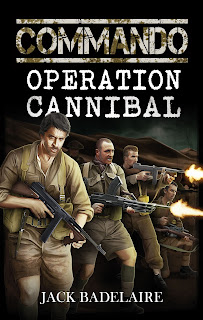
COMMANDO: Operation Cannibal On Sale Now

http://amzn.com/B00GZOS5VQ
Click the Cover to View on Amazon
The third book in the COMMANDO series of World War Two action-adventure novels is now available on Amazon as a Kindle ebook. In the next week or two, I'll have the paperback ready for purchase as well.

Operation Cannibal takes Lynch and the other Commandos to North Africa, where they take on Egyptian spies, German Brandenburgers, and a unit of crack Italian Bersaglieri. There's lots of desert adventure, battles with armored cars and some heavy weapons, as well as gunfights with rifles, submachine guns, knives, grenades...you know - the usual stuff!

Writing this book was a lot of fun, especially as it gave me a chance to delve more into the history and details surrounding the early North African campaign battles. It's amazing how much the war changed between 1941 and 1945, and so much is different than the later Italian and French/German campaigns.

Here's the product description from the Amazon page:

The sands of the North African desert run red with blood as the British Eighth Army battles against the German Afrika Korps. While preparing for a major offensive, the British learn of an enemy raiding unit operating in the deep desert, attacking supply convoys and endangering vital reconnaissance patrols.
Corporal Lynch and his companions find themselves part of a strike force of Commandos and men from the Long Range Desert Group. Their mission: drive deep into the Libyan desert, find the enemy raiders, and wipe them out in a storm of lead.
But when the Commandos discover a nest of Egyptian spies with ties to German Intelligence, has their mission been compromised before it even begins? Will the Commandos find the enemy raiders, or will the hunters become the hunted?
The desert is as dangerous as any enemy in this, the third book in the COMMANDO series of military action-adventure novels written in the spirit of classic war movies and wartime adventure pulp fiction.
 I'll make another announcement when the paperback format is available.

Wednesday, November 6, 2013

Book Review: SUNDANCE #1 by John Benteen

http://amzn.com/B00CJXJI40
Click the Cover to Visit on Amazon
The folks over at Piccadilly Publishing are pretty dang smart. When they grabbed John Benteen's (aka Ben Haas') amazing FARGO series, they were clever enough to also grab his Westerns. This includes his SUNDANCE series, a great haul if for no other reason than the series itself is much longer-lived than FARGO.

Thankfully, there are plenty of reasons why republishing SUNDANCE is great. The eponymous character, Jim Sundance, is a half-white, half-Cheyenne adventurer. When we meet him he's in his 30's, already a man who has roamed and fought across the length and breadth of the U.S., moving between the worlds of the white man and the Indian. The timeframe for the book is sometime a few months after the Battle of Washita River, putting the book most likely in the late spring or early summer of 1869.

Sundance is your typical Benteen hero: tall, broad-shouldered, with a slim waist and a lean, powerful build. He has the complexion and features of a Cheyenne Indian, but his hair is a bright golden blond, a gift from his English father. Sundance received his name - his Indian name - after participating in the Sun Dance ritual, The description given of Sundance's experience is one of the more extreme, although it's got nothing on the movie A Man Called Horse, which has a really graphic Sun Dance ritual scene. I've actually attended a Sioux Sun Dance, and even back in the 90's, there was some ritual body piercing going on, although very rare.

On top of his unusual heritage, Sundance carries an unusual arsenal. In typical Benteen fashion, his main character is very deliberately armed with an assortment of weapons from both cultures. Sundance carries a Navy Colt and a Henry repeating rifle, as well as a Bowie knife with a fourteen-inch blade and a hand guard for knife-fighting. In addition, he carries a steel-bladed tomahawk, as well as a Cheyenne dog soldier's war shield and a bow, along with a quiver of thirty flint-headed arrows. Benteen goes to great length to note that Sundance prefers flint tips to steel, claiming that they deliver a more grievous wound, and that with the bow Sundance could kill a man at four hundred yards, or put an arrow through a buffalo. Over the course of the novel Sundance puts every weapon in his arsenal to use, another Benteen trait, and it is interesting to see how Sundance typically uses the white man's weapons for "every day carry", but when he really means business, he tends to favor his more traditional arsenal. It is a cool dynamic, and having read Sundance #2, one that is probably going to carry through to every book in the series.

As to the plot? Sundance is hired by a railroad baron to find his young, beautiful daughter, who willfully departed for the West Coast some time ago in a well-guarded wagon train. The train was attacked by Indians and the daughter was captured. Being able to move between the two cultures, Sundance is known to be the man you want when it comes to dealing with the Indians, especially the Cheyenne. But, his services don't come cheap. In an interesting twist, and opposed to Neal Fargo, Sundance funnels his fees back to a lawyer in Washington D.C., where the lawyer lobbies for Indian rights in the hope that they can be saved - as much as possible, at least - from the machinations of the white man. Sundance is an educated man, and he's fully aware of how bleak the future of the Indian is in the U.S., so he does what he can to mitigate damage. I think the idea that he's not just spending his money on liquor and whores is an interesting premise, and makes him a more sympathetic character. Without giving away any spoilers, I'll note that this dedication to his cause results in more than a little turmoil over the course of the novel.

Overall, this is an excellent western adventure tale. Sundance is a fascinating character, a mix of some standard Western themes with Benteen's own unique style laid over. The action is fast and violent, the level of detail extraordinary. There's a buffalo hunting scene about halfway through the book that is very impressive, and just as thrilling as any battle sequence.

Even if you're not normally a fan of Western stories, I highly recommend the SUNDANCE series. The $1.99 it'll set you back to buy the first book is well worth the experience, and it was certainly enough to get me to buy #2 the moment it was live (and I read it practically in one sitting).

Thursday, October 31, 2013

Movie Review: The Monster Squad (1987)

During the 80's, a funny thing happened to action movies. First, we started to think of them as "action movies", rather than "violent films". Is Dirty Harry an action movie? I wouldn't call it one. What about Peckinpah's The Getaway? No, I wouldn't call that an action movie, either. Once we hit the 80's, films became big business, "Blockbuster" business, and studios began casting a wider and wider net for their audiences. I lay a lot of this at the feet of the Star Wars films, but even as they were hitting the scene, Indiana Jones and Conan and Beastmaster were arriving, films that were clearly s breed apart from films made a decade previously.

Along with the "action movie" phenomenon, a sub-phenomenon began to occur - the rise of action-adventure movies where children were the heroes. Goonies is probably the most famous example, but you also had films like E.T., Cloak and Dagger, The Lost Boys, Flight of the Navigator, and today's gem, The Monster Squad. All of these films, and a number of others, feature children - often not even teenagers - as the protagonists, often either directly opposed, or at least hindered, by the actions of adults. The great thing about these movies is that it portrayed children as being smart, able to solve problems with creative solutions, and capable of great bravery and courage when necessary. I wrote about this at some length when I reviewed Super 8 back in 2011.

The plot of the movie is pure cheesy fun. Dracula comes to town and brings with him the Wolf Man, the Creature from the Black Lagoon, Frankenstein's Monster, and he even wakes up a Mummy. He also creates a few Brides to cause further mayhem. Dracula is looking for a powerful gem, a physical concentration of pure good, that can be corrupted and used to cause terrible things in the hands of monsters. The Monster Squad, a club of young kids who obsess about monsters, get their hands on an old book that turns out to be the diary of Van Helsing, and inside the diary they read about the gem (with the help of an old German neighbor who "knows all about monsters", being a concentration camp survivor). They discover that the gem is hidden in town, and begin a race against time to find it and save it from the clutches of Dracula and his monstrous allies.

Overall, this is a great Halloween movie. I wound up watching it twice over the last couple of weeks, and it's got action, comedy, horror, and even some real emotion. The kids are all great, the special effects are surprisingly good (Stan Winston Studios), and Duncan Regher's portrayal of Dracula is particularly creepy and effective. There might be a little bit of hamming it up here and there, but he's certainly better than a number of Draculas in cinema over the years.

Here's a great version of the film's trailer on YouTube. The movie is on On Demand with my cable provider right now, but you can pick it up at a reasonable price. If you haven't seen it, or if it's been a good 25 years since you did, the movie is worth a repeat viewing.

And just remember, Wolfman's got nards!


Wednesday, October 23, 2013

Book Review: A Fine Likeness by Sean McLachlan

Click the Cover to View on Amazon
Normally, I'm not really that interested in the American Civil War. I understand the basics of the war - the lead-up, the battles, the conclusion and the aftermath - but for one reason or another I've never felt the need to do a deep dive into this time period. Because of this, I've never had a strong interest in reading any fiction relating to the ACW, such as The Killer Angels or Bernard Cornwell's Nathaniel Starbuck chronicles.

Even with an only lukewarm interest in the conflict, I was intrigued by Sean McLachlan's A Fine Likeness when I first heard about the book. A "Civil War Horror" novel written by a seasoned archaeologist, travel writer, and historical reference author sounded peculiar enough to warrant a second glance, and although it took me a while to circle around to reading it, I'm now kicking myself for waiting so long, because it's one hell of a good yarn.

The book starts off near Columbia, Missouri with a skirmish between Captain Addison's militia company and Rawlins' Rangers, a six-man band of "bushwhackers". The term refers to small bands of guerrilla fighters who operated in many states during the war, launching ambushes and raids and falling back into the wilderness, where the men lived off the land and the generosity of sympathizing civilians. Like the guerrilla fighters of the Napoleonic wars and WW2, these "combatants" occupied a weird middle ground between organized military units and simple armed civilians taking action against their enemies. Missouri was a state absolutely infested with bushwhackers, and due to the fieldcraft of these guerrillas, and their habit of carrying upwards of four six-shot revolvers apiece (opposed by men carrying single-shot long arms), these small bands were often able to cause a degree of havoc and mayhem disproportionate to their numbers.

What starts off as a small battle between Union militia and Confederate guerrillas grows into something a lot more deadly and dangerous when Jimmy Rawlins, the "Captain" of Rawlins' Rangers, gets his band involved with Bloody Bill Anderson, one of the most violent and dangerous guerrilla fighters of the Civil War. I don't want to give away any of the book's twists and turns, but suffice to say the small conflict between militia and bushwhacker is only the facade of a much larger, far more diabolical battle taking place, one that stretches beyond the boundaries of our physical world. Some of the characters are hinted to be far, far more than they appear, and there is a greater "mythos" for lack of a better term, lurking just below the surface of the story.

This is a whole other aspect of A Fine Likeness that should be discussed. At first I thought this was going to be an ACW "ghost story". Because of the war's incredibly brutal nature, and the way it coincided with the rise of spiritualism, mentalism, and the more pseudo-scientific theories regarding ghosts and the spiritual world, there were many people during and after the war who tried contacting dead friends and relatives, and a great deal of fraud was committed by charlatans who preyed upon those who sought them out.  Hand-in-hand with this, a lot of post ACW horror fiction, especially Southern horror, revolved around ghosts and hauntings. So, I figured the author was throwing his hat into the ring, so to speak, and writing a ghost story tied to the Civil War.

While the story does have elements dealing with ghosts and spirits, that's just the tip of the supernatural iceberg, and as I said above, the story makes it clear that there are forces - both sinister and benevolent - at play in a much larger and more active cosmology. This was a pleasant surprise for me, and I feel it shifts the book from being a "Civil War ghost story" to something a lot more like a Weird West tale, similar to the Weird fiction of the 30's written by authors like Robert E. Howard or H.P. Lovecraft, tales that blend history and the supernatural in a way that could be considered "Pulp Horror", although I don't feel that this book really falls into the category of "Pulp". Indeed, I think the only weakness of A Fine Likeness, if there is one, is that I'd be hard-pressed to pin this book down in any sense of a traditional genre. I don't really consider it traditional horror, but the supernatural elements definitely take it out of the realm of historical fiction. I think the author was actually very smart in independently publishing this book, because I can't imagine a traditional publishing house attempting to market this book.

Which reminds me to set any potential reader's fears to rest and point out that this novel is very well-written. The author has a long career writing non-fiction works for established publishers such as Osprey, and that professionalism carries over into this book. I didn't notice any spelling or formatting errors, and the prose overall is very deft - descriptive without being exhaustive, colorful without being overwrought. The author handles both action and dialogue quite well, and every character has their own well-considered "voice".

In conclusion, if you like historical fiction with action and a touch of the supernatural, you cannot go wrong with A Fine Likeness. It's a great novel, and I'm eagerly awaiting the sequel.


Wednesday, October 16, 2013

Book Review: Doom Platoon by Len Levinson

Click the Cover to Visit on Amazon
Originally published by Belmont Tower Books in 1978, this slim novel tells the story of one Sergeant Mazursky, as he leads 2nd Platoon on a desperate mission; to hold back an entire German Panzer division during the opening moves of the Ardennes Offensive, better known to most as the Battle of the Bulge. With only 29 men, can Mazursky and his unlucky few stand their ground and slow the Panzers for the few precious hours their division needs in order to fall back and regroup?

I'm not going to give away any spoilers, but the story takes more than a few twists and turns along the way, dividing itself into three pretty clear arcs. Even though this book was written years before The Sergeant or The Rat Bastards novels, you can certainly see the origins of Mahoney and Butsko in Sgt. Mazursky, as well as the sort of rogues gallery of other squadmates that pop up in those novels, and the sorts of conversations the characters engage in during down time. Writer/Blogger Hank Brown states, and I'll agree, that if you've never read Levinson before this might not be the best introduction to his WW2 fiction, but if you like his war stories already, this would be a neat look into the genesis of those stories.

Overall, this is a really quick read. I zipped through the book start to finish in a long evening's reading, most of it on my cell phone. Ben Bridges of Piccadilly Publishing has partnered with Levinson to publish a bunch of Len's old books under Bridges' own PULP HEAVEN imprint. Overall the ebook version is quite well done, with only a couple of minor formatting errors, probably due to OCR conversion. Other than that, the ebook is very nicely put together, and has a couple of essays at the end written by Levinson, discussing his life and career.


Friday, October 11, 2013

Movie Review: The 13th Warrior (1999)

Recently, I popped this movie in the DVD player and gave it a viewing for the first time in a year or two (I've probably watched it over a dozen times, however). My objectivity surrounding The 13th Warrior, I'll admit, is somewhat shaky. Okay...it's pretty much non-existent. A few of you out there who know me were there, that fateful summer day in August of '99, when we went to see this at the Cheri theater downtown as a matinee. At the time, the main hall of the Cheri was probably one of the biggest, if not the biggest, screen in Boston proper, and so this movie was definitely given a real "cinematic" presentation. I'll always maintain that certain movies need to be seen on the big screen, in the theater, and even today's mega-televisions and home theater sound systems don't compare to what a real movie theater can provide. Perfect evidence of this was when I saw Conan the Barbarian in the theater for the first time about six years ago, and my already favorite fantasy movie suddenly became one of my greatest cinematic experiences, period.

But I digress. The 13th Warrior is adapted from the Michael Crichton novel, Eaters of the Dead, which was in turn his attempt at writing a "historical" interpretation of Beowulf, using some fake "found documentation". Written in 1976, it was one of his earlier novels, written way before Jurassic Park, when he was just another writer turning out cool books in various genres. The premise, in a sentence or two, is that the story follows an Arab diplomat as he gets caught up with a band of Viking badasses as they venture far into the hinterlands of Scandinavia to do battle with a horde of, to put it simply, cannibalistic Neanderthals. Crichton uses the cave-dwelling, fire-toting savages as the stand-in for Grendel, the Dragon, and Grendel's Mother.

Right there is the first problem - when you explain the plot of the film, it sounds a lot dumber than it is. there's a great deal of superstition and mystery surrounding the "Wendol" as they are known, and the Vikings all believe them to be actual supernatural creatures, a race of legendary were-bear creatures that are half man, half beast, lurking in the deep forests and appearing in the night with the mist, to raid and kill and make off with the heads of dead men, and most disturbingly, "...it is said...they eat the dead...". Thus, the name of the book.

The movie also had a very difficult birth. John McTiernan started directing it, and then there were severe creative differences between him and Creighton, to the point where McTiernan left and Crichton finished directing the film (at this point Crichton had already directed a successful film, so this wasn't necessarily a dumb decision on the part of the studio). The movie does exhibit a kind of mixed personality disorder; it doesn't know if it should be horrifying and scary, or more straight action-adventure. The Vikings are also very..."Mythical" is how I like to put it. All the badasses wear armor and clothing that come from a wide range of cultures and time frames, many of them anachronistic. There were a LOT of people who tore the movie apart on this factor alone. I look at it as simply representing the Vikings as widely traveled adventurers, who've been to a lot of different, exotic locales.

In addition, there is the infamous "I listened!" language montage. If you're actually paying attention, it is pretty clear that Antonio Bandaras' character is spending weeks traveling with the Vikings, and as an educated man who probably speaks a couple of languages already, he over time picks up bits and pieces of the Viking's language, until he surprises them by being able to speak their tongue pretty well. Many folks thought this process took a couple of days, perhaps as short as a single night, which isn't really supported by the montage unless you're not really paying attention. Ultimately, it is a gimmick to get around a language barrier that would've killed the story before it even began (not that some critics would be upset by that). Ultimately, I think it is fine; if the Stargate television series can get away with EVERYONE IN THE UNIVERSE speaking perfectly understandable English, then I think we're okay here.

Beyond these and some other criticisms of varying merit, I think this movie is flat out one of the best historical action-adventure movies of the last twenty years. The Viking Band is so perfectly cast, so well-populated with these tough, gritty, steely-eyed asskickers. The dialogue might be a little hammy, but it is so well-suited to the badassitude of the movie that it just plain works. A few quotes snagged from IMDB:

Herger the Joyous: When they come, we form a circle in the center of the room, backs to one another.
Ahmed Ibn Fahdlan: I am not a warrior.
Herger the Joyous: Very soon, you will be. 

Ahmed Ibn Fahdlan: Have we anything resembling a plan?
Herger the Joyous: Mm-hm. Ride till we find them... and kill them all. 

Buliwyf: I have only these hands. I will die a pauper.
King Hrothgar: You will be buried as a king.
Buliwyf: A man might be thought wealthy if someone were to draw the story of his deeds, that they may be remembered.
Ahmed Ibn Fahdlan: Such a man might be thought wealthy indeed.

I also want to emphasize that, although this movie at some points isn't sure if it wants notes of horror or pure adventure, in many ways, it is still a good blend. The Wendol, until you get what they are later on, are a creepy, evil, almost goblin-esque race that hide in the shadows and "come in the mist". It isn't until about halfway through the movie that the characters can confirm that their opponents are simply men who dress and think of themselves as bears. The dark, misty, foreboding nature of the landscape, as well as the more disturbing scenes inside the caverns of the Wendol also contribute to the eerie quality of the movie, as does Jerry Goldsmith's incredible score. In fact, for years I used the soundtrack as tabletop role-playing game "mood music" because it just carried such a sense of adventure, mystery, suspense, and horror, all mixed together. Like another one of my favorites, The Brotherhood of the Wolf, the "supernatural" elements lend a horror to the story that complements the action in my mind, rather than subtracting from it.

All in all, it is a shame this movie is considered such a disaster. It was extremely expensive to make, re-shoot, and market, and made back only a fraction of its costs ($60m in revenue vs. $160m in expenses). The financial failure of this film, I think, colors for many people the overall quality of the film, as many probably were introduced to it over the years already knowing it was a flop. On the other hand, there is a small, but quite strong, following for this film out there, mostly folks who understand it for what it is - an epic, mythic adventure story. Novelist and movie critic Stephen Hunter reviewed the film when it came out, and his review from the Washington Post can still be found here. Hint: he opens with, "Think of "The 13th Warrior" as Akira Kurosawa's "The Seven Samurai" jacked on amphetamines."