Monday, January 27, 2014

A Writer's Sandbox: Dungeons and Dragons Turns 40 and Keeps on Rolling

Where it all started
Twenty years ago, I began playing Dungeons and Dragons. For the longest time, I had almost no interest in Fantasy as a genre, preferring Tom Clancy or Able Team or some dog-eared Vietnam memoir. But my friend Joey loaned me the first three Dragonlance novels, and I was weirdly hooked.

That of course is a real signifier as to the fact that I'm not an "old school" D&D gamer. many of them consider the mid-80's advent of the Dragonlance media tie-in fantasy novels, and the game setting they're based on, to be the game's true death-knell. To many, taking the game away from the small, grubby stories of treasure hunters and scoundrelous tomb-robbers and featuring epic, save-the-world style quests with Good and Evil standing against each other was anathema to what the game was all about.


Unfortunately for these grumbly grognards, this newer kind of gameplay not only became popular, it became, in a way, the de facto sort of game played by D&D groups. A ragtag band of heroes - a fellowship, if you will - comes together to take on a quest to defeat some ancient evil that threatens the land. As the characters grow in experience and become more badass, the threats they encounter likewise become more terrible, almost as if some higher power were making sure they were challenged, but not too challenged, in their adventures...

But that's a whole other article for another day.

Let's be honest. This is badass.
The summer of 1993, Joey and our friend Josh both brought over the "Big Black Box" version of the Basic D&D game, and my life changed forever. Although looking back on it we didn't actually game that much, I was immediately captivated by this thing, this systematic framework around which you could create characters and worlds and adventures. My interest in D&D quickly outstripped theirs, and within two years I'd bought almost every rule book and supplement published for what was then the second edition of Advanced Dungeons & Dragons (D&D would drop the "Advanced" after this edition, as by this time there was no real Basic vs. Advanced rules breakdown). I also bought a ridiculous amount of D&D media tie-in novels, most of which I've not cracked again in almost two decades (mostly because, frankly, a lot of them weren't that great).

For years before this, I'd been an amateur writer, penning or typing stories, usually (okay, always) of a violent nature. It was a perfectly healthy reflection of all the violent crap I read at the time, and when I started getting into D&D, I started writing fantasy stories as well. A lot of people take potshots at gaming fiction, painting those who play the game and build adventures as frustrated writers who can't actually commit to writing their own original material. While there is no doubt some merit to this, I actually think that gaming and writing can go hand in hand and be mutually supportive.

This is some epic-level shit going down.

I realize now, engaging in the world-building of creating a campaign setting, the D&D player is learning the same tools that writers need in order to flesh out the "worlds" they write, even if those worlds are historical or contemporary to the writer. You learn how to build characters, give them motivations, connect story lines and look back at the origin of a conflict, as well as forward to the inevitable resolution. You think of infrastructures and consequences, creating mood and drama, finding themes and setting tone.  You learn how to challenge your protagonists, and to make sure that the scale of the challenges they face falls within the sweet spot of tough enough to make things exciting and worthwhile, but not so hard that everyone gets slaughtered, or some deus ex machina is needed to pull everyone's bacon out of the fire. You learn that when a character dies, all the player (aka, reader) asks is that they die well, with a bloody sword in hand and a pile of foes all around. And when the bad guy gets his comeuppance, it's satisfying and worth all the trials and tribulations that came before.

So here's to you, Dungeons and Dragons. Forty years and still going strong, the grandfather of all role-playing games - including most modern video games - and the sandbox where so many writers created their first stories.

Tuesday, January 21, 2014

IRON HEAD and Other Stories Charity Anthology on Sale Now

http://amzn.com/B00HXYI2DS
Click the Cover to See on Amazon
I'm happy to announce the first Fight Card charity anthology, IRON HEAD and Other Stories, is now live on Amazon.com as an ebook. This is the first of several charity anthologies to be published by the folks who've been bringing you two-fisted fight fiction for the last couple of years. Here's the product description: 

Fight Card Presents: Iron Head & Other Stories is the first in a series of charity anthologies from the Fight Card authors cooperative – a writers community featuring many of today’s finest fictioneers, including Jory Sherman, Ryan McFadden, Mark Finn, Troy D. Smith, Ed Greenwood,  Jack Badelaire, James Scott Bell, James Hopwood, Bowie V. Ibarra, and Matthew Pizzolato.

Compiled by Paul Bishop and Jeremy L. C. Jones, 100% of the proceeds from these anthologies will go directly to an author-in-need (in this case, revered western writer Jory Sherman) or a literacy charity. Words on paper are the life blood of a writer.  The writers in this volume were willing to bleed in order to give a transfusion to one of their own – and then continue to bleed to give a transfusion to literacy charities in support of that most precious of commodities ... readers.  They are true fighters, every one ...

I was lucky enough to be asked to write a fight story for the anthology, and not only was it accepted, but it was included in this, the first of (at least) four volumes. My story, "A Sergeant's Duty", features every COMMANDO fan's favorite Highlander Sergeant, Dougal McTeague, as he tries to find his sense of duty and purpose (and bash a few skulls along the way) after the British Expeditionary Force's defeat in 1940.

So, if you're looking to do your good deed for the day, you're a fan of pulpy fight stories, or (perhaps) you're a fan of my COMMANDO series, there's no better way to spend $1.99 today than picking up IRON HEAD & Other Stories. Great fiction for a great cause at an unbeatable price.

Tuesday, January 7, 2014

SPIDERS AND FLIES Sword and Sorcery Fantasy Novella On Sale Now


http://amzn.com/B00HNY0H9U
Click the Cover to See on Amazon

Every writer has their “desk-drawer novel” written once upon a time but never brought out to see the light of day or the eyes of other readers. Spiders and Flies is my desk-drawer novel, or novella, rather, written in the spring and summer of 2001 as a means of establishing in my mind a world that would eventually become a role-playing game campaign setting. That campaign, which I named Year of the Blood Wolf, was one of my favorites as a game-master.

At the time, I wrote Spiders and Flies as an homage of sorts to the classic pulp tales of writers such as Robert E. Howard, Lin Carter, Karl Edward Wagner, and Gardner F. Fox. I wanted to create an exotic world of danger and adventure, swordplay and sorcery, hidden terrors and long-forgotten treasures. I wanted characters who lived somewhere in the grey area between hero and scoundrel, daring rogues who’d risk their lives for the thrill of adventure. 

Looking back on this story twelve years later, I’d like to think I’ve succeeded at that goal, although I leave it to the reader to decide on whether or not I was successful. Either way, I’m glad to be able to take this story out of the desk drawer, so to speak, and publish it at last.

Here's the product description for Spiders and Flies:
In a shady border-town tavern, the swordsman Rovan conspires with his old comrade Arvik Red-Hand to carry out a daring plan to pay off a blood-debt: ride deep into the desert and loot the abandoned temple of a long-dead spider god.

When old enemies come to collect Arvik's head, he and Rovan are rescued by Marquia, a mysterious sorceress, and Souvri, a cunning thief. Believing the two could prove valuable, Arvik and Rovan share the plan with their rescuers, who agree to join the adventure - for a healthy share of the spoils.

The four treasure-hunters face danger on every step of their journey, and finally they discover the spider god's temple might not be abandoned after all...

SPIDERS AND FLIES is a 20,000 word novella, written as an homage to classic Sword & Sorcery pulp fantasy stories filled with magic and monsters, thievery and swordplay, hidden horrors and forgotten treasures.
I'm working on the paperback version of S&F, which should be out in the next week or so. When it is, I'll let folks now.

Tuesday, December 31, 2013

Jack Badelaire's 2014 Short Story Challenge

2013 was the year I became a writer. I don't say this as a boast or to beat my own drum, but rather because I decided this year that writing four novels wasn't just a flash in the pan for me, something to get out of my system, reflect on with the taste of sour grapes in my mouth, and move on. I know now that I'm in this for the long haul.

I also know that in 2014, I need to step up my game. I need to either be writing, editing, or in some other way working on one project or another every single day. It doesn't matter if I work for ten minutes or a full, eight-hour day - I've got to do it. Right now, I'm in a plane and I'm taking off from the runway, and I've got to push those throttles against the stops. Either I gain enough airspeed and altitude to clear the trees at the end of the runway, or I'm going to stall out and crash. This is a vulnerable time for me, and I know the only way to make it through is to write and close, write and close, write and close. I have to remember - coffee is for closers.

A year ago I posted this article on how I need to always be closing in 2013. I didn't think my goals were unreasonable, but I failed to achieve some of them. Why? Because in April, a fluke of chance right as Operation Bedlam went live meant I made quite a bit of money over the spring and summer, and that money made me lazy. Instead of writing Operation Cannibal in two months, it took me five. Instead of getting Spiders and Flies out of my desk drawer in 2013, I'm going to have to get it published in January. I did write another short story, but it wasn't the one I wanted. I let a small taste of success go to my head, and my hands got soft. I've got to build up my calluses again, and I need a challenge to keep driving me forward.

So in 2014, I'm throwing down the gauntlet - not just for myself, but for all of you, too. Here's how it's going to work:
  1. Go and look at your bookshelves. Find a book or two that you've read, in a genre you like, and re-read them. Right now. You're going to write a short story in the spirit of those books.
  2. Put a dollar bill in a coffee can. This can is your Cover Can. Put another dollar in that can every day.
  3. Write at least 300 words a day, every day, for six weeks. That's 12,600 words. If you fall a little short or run a little over, that's fine. The goal is to write a short story between 10,000 and 15,000 words. But seriously, at least three hundred, you big sissy.
  4. Once the story is finished, over the next four weeks you're going to get (at least) four people to read that short story and provide feedback. Two of them need to be anal retentive grammar Nazis who'll slap you senseless for every little typo and screw up. Two of them need to be the sort of folks who read mostly for pleasure and like the kind of fiction you're writing - they represent the people who'd pay money for your story.
  5. Once those four weeks are up, spend the next two weeks editing the story, factoring in all the grammar and spelling edits, any suggestions that seem to make sense to you, and ignoring some that your gut tells you don't work. Remember, at the end of it all, it's your story.
  6. After these twelve weeks, your story is done. Stop mucking with it and tweaking and fiddling. At this point, there's as much a chance of you breaking something that isn't broken as there is of you finding something that could use some improvement. Perfection is the enemy of Good Enough.
  7. Return to Step 1 and begin this process over again.
  8. When you're not working on the next short story, take the 84 dollars you've got in your Cover Can and find a cover artist. DeviantArt is one option, but there are a million others. You can get a good, professional, embarrassment-free cover for 80-100 dollars. Go forth and do so now.
  9. Read up on how to format your short story for the Kindle, and make it happen. I've gotten to the point where I can format a Word document for the kindle in about 10 minutes, minus proof-checking. As long as you keep things simple, you can too.
  10. If you aren't signed up for KDP already, make an account, then create a new title, fill in all the relevant details, upload your new cover and that Kindle-ready file, then hit Publish.
  11. Do this four times before January 1st, 2015.
I already have the ideas for my four short stories. Two of them are Secret Projects that I'm not yet at liberty to discuss. A third is a fantasy short story, and the fourth is another Resistance short for the Commando series. These are going to be in addition to all the other things I want to accomplish in 2014, but if I'm going to clear the treeline at the end of the runway and make a successful takeoff, this is how it's going to happen.

Anyone care to join me?

Monday, December 2, 2013

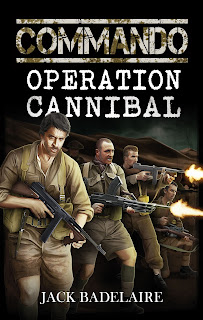
COMMANDO: Operation Cannibal On Sale Now

http://amzn.com/B00GZOS5VQ
Click the Cover to View on Amazon
The third book in the COMMANDO series of World War Two action-adventure novels is now available on Amazon as a Kindle ebook. In the next week or two, I'll have the paperback ready for purchase as well.

Operation Cannibal takes Lynch and the other Commandos to North Africa, where they take on Egyptian spies, German Brandenburgers, and a unit of crack Italian Bersaglieri. There's lots of desert adventure, battles with armored cars and some heavy weapons, as well as gunfights with rifles, submachine guns, knives, grenades...you know - the usual stuff!

Writing this book was a lot of fun, especially as it gave me a chance to delve more into the history and details surrounding the early North African campaign battles. It's amazing how much the war changed between 1941 and 1945, and so much is different than the later Italian and French/German campaigns.

Here's the product description from the Amazon page:

The sands of the North African desert run red with blood as the British Eighth Army battles against the German Afrika Korps. While preparing for a major offensive, the British learn of an enemy raiding unit operating in the deep desert, attacking supply convoys and endangering vital reconnaissance patrols.
Corporal Lynch and his companions find themselves part of a strike force of Commandos and men from the Long Range Desert Group. Their mission: drive deep into the Libyan desert, find the enemy raiders, and wipe them out in a storm of lead.
But when the Commandos discover a nest of Egyptian spies with ties to German Intelligence, has their mission been compromised before it even begins? Will the Commandos find the enemy raiders, or will the hunters become the hunted?
The desert is as dangerous as any enemy in this, the third book in the COMMANDO series of military action-adventure novels written in the spirit of classic war movies and wartime adventure pulp fiction.
 I'll make another announcement when the paperback format is available.

Wednesday, November 6, 2013

Book Review: SUNDANCE #1 by John Benteen

http://amzn.com/B00CJXJI40
Click the Cover to Visit on Amazon
The folks over at Piccadilly Publishing are pretty dang smart. When they grabbed John Benteen's (aka Ben Haas') amazing FARGO series, they were clever enough to also grab his Westerns. This includes his SUNDANCE series, a great haul if for no other reason than the series itself is much longer-lived than FARGO.

Thankfully, there are plenty of reasons why republishing SUNDANCE is great. The eponymous character, Jim Sundance, is a half-white, half-Cheyenne adventurer. When we meet him he's in his 30's, already a man who has roamed and fought across the length and breadth of the U.S., moving between the worlds of the white man and the Indian. The timeframe for the book is sometime a few months after the Battle of Washita River, putting the book most likely in the late spring or early summer of 1869.

Sundance is your typical Benteen hero: tall, broad-shouldered, with a slim waist and a lean, powerful build. He has the complexion and features of a Cheyenne Indian, but his hair is a bright golden blond, a gift from his English father. Sundance received his name - his Indian name - after participating in the Sun Dance ritual, The description given of Sundance's experience is one of the more extreme, although it's got nothing on the movie A Man Called Horse, which has a really graphic Sun Dance ritual scene. I've actually attended a Sioux Sun Dance, and even back in the 90's, there was some ritual body piercing going on, although very rare.

On top of his unusual heritage, Sundance carries an unusual arsenal. In typical Benteen fashion, his main character is very deliberately armed with an assortment of weapons from both cultures. Sundance carries a Navy Colt and a Henry repeating rifle, as well as a Bowie knife with a fourteen-inch blade and a hand guard for knife-fighting. In addition, he carries a steel-bladed tomahawk, as well as a Cheyenne dog soldier's war shield and a bow, along with a quiver of thirty flint-headed arrows. Benteen goes to great length to note that Sundance prefers flint tips to steel, claiming that they deliver a more grievous wound, and that with the bow Sundance could kill a man at four hundred yards, or put an arrow through a buffalo. Over the course of the novel Sundance puts every weapon in his arsenal to use, another Benteen trait, and it is interesting to see how Sundance typically uses the white man's weapons for "every day carry", but when he really means business, he tends to favor his more traditional arsenal. It is a cool dynamic, and having read Sundance #2, one that is probably going to carry through to every book in the series.

As to the plot? Sundance is hired by a railroad baron to find his young, beautiful daughter, who willfully departed for the West Coast some time ago in a well-guarded wagon train. The train was attacked by Indians and the daughter was captured. Being able to move between the two cultures, Sundance is known to be the man you want when it comes to dealing with the Indians, especially the Cheyenne. But, his services don't come cheap. In an interesting twist, and opposed to Neal Fargo, Sundance funnels his fees back to a lawyer in Washington D.C., where the lawyer lobbies for Indian rights in the hope that they can be saved - as much as possible, at least - from the machinations of the white man. Sundance is an educated man, and he's fully aware of how bleak the future of the Indian is in the U.S., so he does what he can to mitigate damage. I think the idea that he's not just spending his money on liquor and whores is an interesting premise, and makes him a more sympathetic character. Without giving away any spoilers, I'll note that this dedication to his cause results in more than a little turmoil over the course of the novel.

Overall, this is an excellent western adventure tale. Sundance is a fascinating character, a mix of some standard Western themes with Benteen's own unique style laid over. The action is fast and violent, the level of detail extraordinary. There's a buffalo hunting scene about halfway through the book that is very impressive, and just as thrilling as any battle sequence.

Even if you're not normally a fan of Western stories, I highly recommend the SUNDANCE series. The $1.99 it'll set you back to buy the first book is well worth the experience, and it was certainly enough to get me to buy #2 the moment it was live (and I read it practically in one sitting).

Thursday, October 31, 2013

Movie Review: The Monster Squad (1987)

During the 80's, a funny thing happened to action movies. First, we started to think of them as "action movies", rather than "violent films". Is Dirty Harry an action movie? I wouldn't call it one. What about Peckinpah's The Getaway? No, I wouldn't call that an action movie, either. Once we hit the 80's, films became big business, "Blockbuster" business, and studios began casting a wider and wider net for their audiences. I lay a lot of this at the feet of the Star Wars films, but even as they were hitting the scene, Indiana Jones and Conan and Beastmaster were arriving, films that were clearly s breed apart from films made a decade previously.

Along with the "action movie" phenomenon, a sub-phenomenon began to occur - the rise of action-adventure movies where children were the heroes. Goonies is probably the most famous example, but you also had films like E.T., Cloak and Dagger, The Lost Boys, Flight of the Navigator, and today's gem, The Monster Squad. All of these films, and a number of others, feature children - often not even teenagers - as the protagonists, often either directly opposed, or at least hindered, by the actions of adults. The great thing about these movies is that it portrayed children as being smart, able to solve problems with creative solutions, and capable of great bravery and courage when necessary. I wrote about this at some length when I reviewed Super 8 back in 2011.

The plot of the movie is pure cheesy fun. Dracula comes to town and brings with him the Wolf Man, the Creature from the Black Lagoon, Frankenstein's Monster, and he even wakes up a Mummy. He also creates a few Brides to cause further mayhem. Dracula is looking for a powerful gem, a physical concentration of pure good, that can be corrupted and used to cause terrible things in the hands of monsters. The Monster Squad, a club of young kids who obsess about monsters, get their hands on an old book that turns out to be the diary of Van Helsing, and inside the diary they read about the gem (with the help of an old German neighbor who "knows all about monsters", being a concentration camp survivor). They discover that the gem is hidden in town, and begin a race against time to find it and save it from the clutches of Dracula and his monstrous allies.

Overall, this is a great Halloween movie. I wound up watching it twice over the last couple of weeks, and it's got action, comedy, horror, and even some real emotion. The kids are all great, the special effects are surprisingly good (Stan Winston Studios), and Duncan Regher's portrayal of Dracula is particularly creepy and effective. There might be a little bit of hamming it up here and there, but he's certainly better than a number of Draculas in cinema over the years.

Here's a great version of the film's trailer on YouTube. The movie is on On Demand with my cable provider right now, but you can pick it up at a reasonable price. If you haven't seen it, or if it's been a good 25 years since you did, the movie is worth a repeat viewing.

And just remember, Wolfman's got nards!